- Home Page
- Popular Kites
- Roller Kite
The Roller Kite
Some Background
The roller kite has been around since the 1930s, although not by that name. In the early 1970s, Alick Pearson simplified and improved an older kite design called the Roloplan.
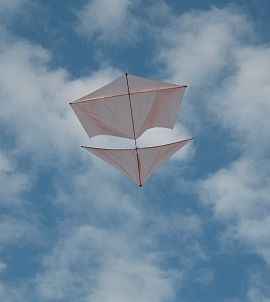 MBK Dowel Roller
The original roller kite was not large, at just 120 x 120 centimeters (46 x 46 inches).
Also, it is claimed by some that the roller was the first
well-known kite to use ripstop nylon for sail material. I wonder if it
was spinnaker fabric as is sometimes used even today. Perhaps Pearson
had sailing connections in those days.
This new design became influential, and many people refer to it (or similar kites) as the Pearson roller.
Some say that the roller looks somewhat like a rokkaku with a slot
cut in it! I suppose some versions that are taller than they are wide
could remind you of a rok if you mentally cover over the vent between
the upper and lower sails.
Like the rok, the roller is a stable tailless design.
In fact, the keel and large vent between the upper and lower sails make this design even more stable than many other similarly-sized kites.
The
nice red kite in the photo further down is a home-built roller by Marty
Groet. The image was used with permission. At the time of writing, Marty was a keen member of the Wings
Across Carolina Kiting and Okra Society in the USA.
On this site, there's more kite-making info than you can poke a stick at. :-)
Want to know the most convenient way of using it all?
The Big MBK E-book Bundle is a collection of downloads—printable PDF files which provide step-by-step instructions for many kites large and small.
Every kite in every MBK series.
Here are some general points about rollers:
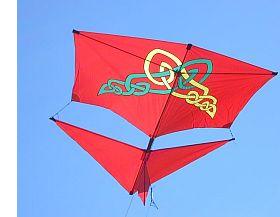 Homemade roller in ripstop nylon
- Rollers can be seen in a variety of sizes from the original dimensions through to 2 or 3 meters (10 feet) in height.
- Slight variations in the original outline are common.
- Wooden or carbon spars are usually used for this type of kite.
- A tail is not necessary for a well-constructed roller of at least average size.
- Some beautifully decorated roller kites have been made and displayed at festivals over the years.
- A two-leg bridle is often combined with small keels under the upper and/or lower sails.
- For sail material, ripstop nylon is commonly used.
Here's a few comments on each of the above points:
Size. Nothing to add, except that the MBK 1-Skewer Roller is a rare miniature!
Shape. Many designers who choose to do a roller decide to make it taller than the span from tip to tip. This would make it slightly more stable, an advantage for inexperienced kite fliers. The amount of taper in the upper sail can vary from design to design. So too can the exact shape of the triangular lower sail, with some being quite deep compared to the original. Mind you, there are also a few examples out there where the designer has gone far from the original design and they look nothing like a Pearson roller! For example, one is basically a rok with a couple of vents cut into it. Another is loosely based on the Pearson design but has a V-shaped trailing edge on the upper sail and a diamond-shaped lower sail!
Construction. This kite is traditionally made with 150 degrees of dihedral in both horizontal spars, although using a bow string would achieve the same stability when properly adjusted. Wooden spars are often used, although carbon spars of slightly smaller diameter are sometimes used instead. The spar ends are fitted into pockets in the sail, and bands are used to tie the spars together where they cross. Interestingly, on one big retail kite, the lines connecting the sails are adjustable at the tips but not at the center.
Tails. As already mentioned, the roller kite does not need a tail. My little MBK 1-Skewer Roller does, though, because at such a small scale it's very difficult to construct it accurately enough to fly tailless.
Decoration. There's plenty of "canvas" on a bigger-than-average roller for a builder to get artistic! An excellent example is an Australian design that has been mass produced in China for the shops. It's a kangaroo design that features ochre colors: browns, reds, and yellows. Brown kites haven't been seen much since the early days of kids making diamond kites from brown paper and string!
Bridle. The original roller had a simple two-leg bridle with the lower point attached to a small keel. The keel itself was tied to the lower end of the vertical spar and the midpoint of the lower horizontal spar through two eyelets. A short length of spar was also sewn to the keel itself. Later versions of this kite often had a similar keel at the upper bridle point as well. I personally can't see why. It's extra complexity added for a dubious increase in stability, I reckon! Some of these later kites also had the keel(s) sewn directly to the sail, which is a fairly standard practice in kite making.
Sail. The original kite apparently used ripstop nylon, and many versions since then would have used the same. I'm sure a range of other modern kite-sail materials have also been used since then, particularly on the homemade versions.
Like to see a video clip? Just scroll down to near the end of this page.
Roller Kites in Action
It seems these kites have always been "fly for pleasure." I've corresponded with one or two people who have owned a quality roller kite in the past and loved it.
Out in the Field
Roller-kite stories of my real-life flying experiences are worth checking out!
Illustrated with photos and videos, of course.
Rollers look quite different to the more common diamonds and deltas and they fly at line angles somewhere between those two types. Mind you, a great roller might fly higher than an average delta!
Apparently, a large roller has only a moderate line pull, like a large delta. Large and artistically decorated examples of these kites have sometimes featured at kite festivals.
I wonder when someone will put up a rokkaku and a Pearson roller with a rock soundtrack blaring through the PA. Rok'n'Roller ... get it ... never mind.
Some Roller Kite History
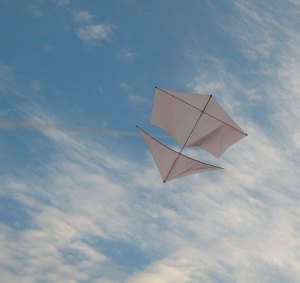 MBK Dowel Roller
It's just a few snippets of history; there's not a lot to say. A little should be said about the old Roloplan kite, since it was the forerunner of the Pearson roller, and a quick glance at the plans will confirm how similar the two kite designs are.
The Roloplan was marketed by Steiff, a German toy manufacturer in the 1930s. This kite became very popular in the UK for a time, particularly in London where it coped well with small-park flying. Many people at the time thought it was actually a British design! Copying this kite accurately would have been a tiresome chore because of the fiddly bridling and multiple line connections between the upper and lower sails. No wonder an Englishman decided to redesign it into a much simpler kite, while retaining the original outline and vented sail concept.
Pearson did such a good job, an influential kite-book author (Pelham) included it in the next edition of his book. Also, the design was manufactured in fairly large numbers, and so it blossomed in popularity during the late 1970s and early 1980s.
After this time, the roller found it had some stiff competition as a light-wind kite; enter the Delta, Genki, and a few others!
However, you can't keep a good kite down. All it takes is for someone to show off a particularly good example or two at a big kite festival, and some interest among kite-lovers can be reignited. Due to an appearance here, an article there, or a popular web page somewhere else, those kinds of things can be triggers for an old but good design to begin gathering a new following.
The video below shows our homemade Dowel Roller on a short line in a gusty breeze.
A good shop-bought roller kite will set you back more than US$100, and some of them take a little while to set up, since they are designed to break down into a fairly small carry bag. But hey, if you want a great-performing light-wind kite that isn't instantly recognizable by most people—get a roller!
As mentioned earlier, there's more kite making on this site than you can poke a stick at. :-)
Want to know the most convenient way of using it all?
The Big MBK E-book Bundle is a collection of downloads—printable PDF files that provide step-by-step instructions for many kites large and small.
That's every kite in every MBK series.
