Large Kites
You Mean Big or Positively Giant?
Without delving into too much detail about specific large kites, here are a few notes about the very biggest such creations in the world. And if you do want a bit more info about specific kites, there's a link down near the end of the next section.
Show Kites
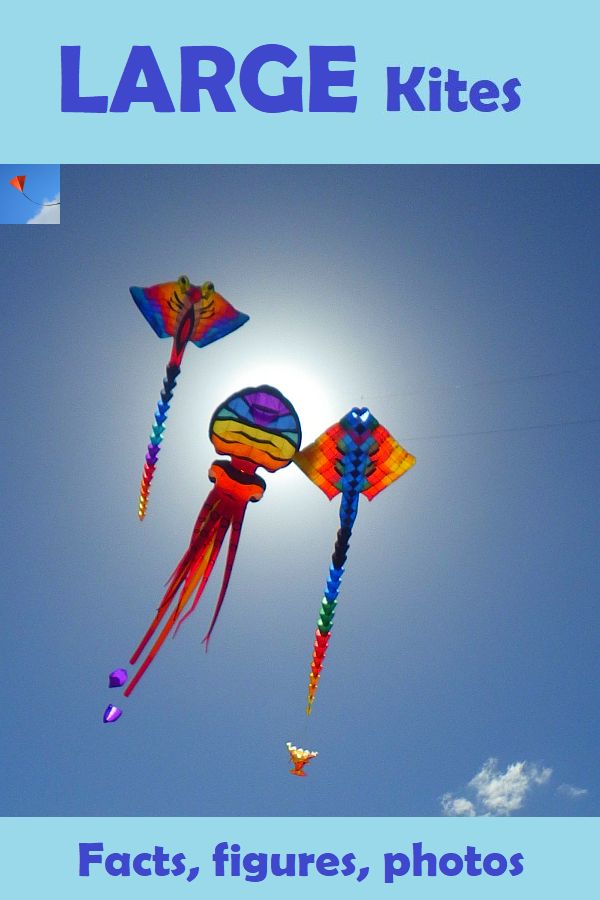
Big kite festivals almost always feature impressively-sized inflatable kites which are popular with the crowds. The most common theme seems to be sea creatures. This has a lot to do with the intriguingly realistic movement these kites exhibit as they gracefully distort and sway in the air. The impression is like swimming.
(Regarding that pinnable image—it's much bigger when pinned.)
Although not a real creature, my favorite was an extremely detailed and long dragon inflatable which I saw at the Adelaide International Kite Festival in March 2009.
Several years later, at the same event, we saw a huge colorful ray inflatable floating over the sand. See the video at the bottom of this page.
The photo below is of the biggest kite my family has seen so far, a blue-whale inflatable!
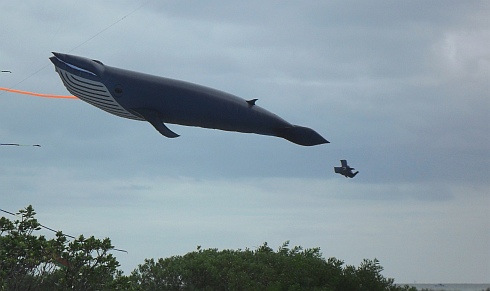 Life-size blue-whale inflatable!
On this site, there's more kite-making info than you can poke a stick at :-)
Want to know the most convenient way of using it all?
The Big MBK E-book Bundle is a collection of downloads—printable PDF files which provide step-by-step instructions for many kites large and small.
Every kite in every MBK series.
Several Asian cultures have been flying truly enormous kites for centuries. For example, in Japan, rectangular giant kites are flown on special occasions. Each kite has dozens of lines attached all over its face. A large team of men is required to hold the lines as the kite soars up in a fresh breeze. These are not light-wind kites!
Peter Lynn, the well-known kite designer, has created several huge "soft" kites that compare in size to an entire football field! These have been flown at various international kite festivals around the world. In contrast to the Japanese giants, these large kites require relatively light, smooth winds.
Check out these examples of giant kites from around the world, including those mentioned above. They are big in different ways—volume, length, or weight.
Costs of Large Kites
Size alone doesn't determine price. However, for a given kind of kite, this is true since the costs of materials goes up with increasing size. If the wingspan is doubled, the total sail area is four times greater. Complexity is another factor. Some of the single-line parafoils require huge numbers of stitches and have complex bridles. Hence, the labor costs push up the prices of these big kites.
Here are a few general categories regarding cost:
- For just a few dollars, you can put together your very own impressively sized single-line kites from widely-available materials. For example, see the largest of our own MBK designs, which you can read about in the kite-making section of this site. Better still, type in "multi-dowel" in the search box up there! This approach is probably more about the fun of building rather than saving money. It's satisfying to see your own large kites up there!
- For around the 10–20 dollar mark, kite shops will sell you some reasonably big mass-produced kites. Obviously, for this price, great build quality and performance cannot be guaranteed! It's not much to pay for an introduction to the hobby though.
- Quality kites from shops, whether single-line or multi-line, can cost a lot more. Talk to the sellers to find out the strengths and flying characteristics of a particular kite. The inflatables stand out as the most impressive and expensive kinds of kites. Don't try hand-flying one of these on its 500-pound line!
- Finally, there are a fairly small number of dedicated craftsmen out there who produce and sell their own specialized designs. These guys tend to be known for just one kind of kite. For example: Codys, roks or deltas. While these large kites are small enough to be hand-flown by an adult, prices can still be in the 100s of dollars. In some cases you are paying for dozens of hours of skilled art-work. In other cases, top-quality materials and superbly accurate construction explains the cost.
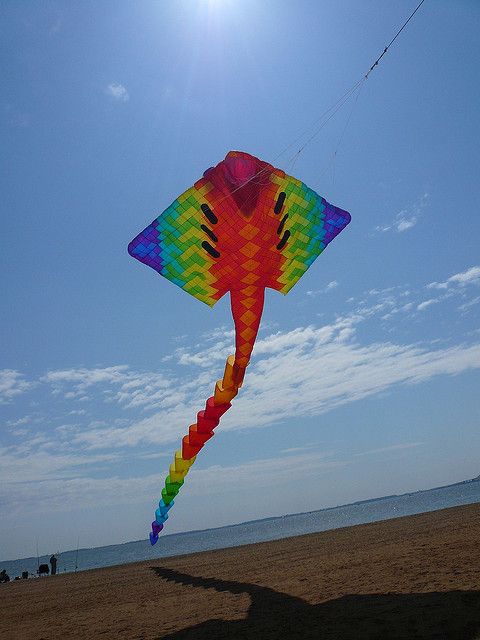
Here's a photo of one of those inflatables mentioned earlier.
It's a Maxi Ray by Peter Lynn. The size isn't evident from the photo, so
here are the figures—it spans 9.8 meters (32 feet) and is 29 meters (96
feet) long!
Owning Large Kites
Let's consider what owning large kites might mean. Four things came to my mind:
- You won't be able to fit it in your car when fully rigged. Hence, it should break down to a manageable package. Parafoils and inflatables just stuff into a bag. Easy peasy.
- The kite will pull strongly in moderate breezes and become a real handful in fresh winds. Of course, if you are into flying big stunt kites, this might be half the fun!
- The impressive size and perhaps colorful design will be sure to draw attention, particularly if you are flying an inflatable creature kite of some kind. I wonder if these are some kind of kiting status symbol—they sure cost a bit.
- It might cost quite a bit, but some sizeable single-liners are surprisingly cheap.
That list at the top also touches on four common types of large kites:
- Single-line parafoils or flowforms. Li-lo's (inflatable mattresses) in the sky!
- Single-line deltas or other flat and bowed types such as rokkakus.
- Dual-line delta stunt kites. Very popular!
- Those incredible inflatable creatures you see at kite festivals. Actually, many of these are made in smaller sizes too, bringing the costs down a lot.
As mentioned earlier, there's more kite-making on this site than you can poke a stick at :-)
Want to know the most convenient way of using it all?
The Big MBK E-book Bundle is a collection of downloads—printable PDF files which provide step-by-step instructions for many kites large and small.
Every kite in every MBK series.

