- Home Page
- Asian Kites
- Chinese Kites
- Dragon Kites
Dragon Kites
Big or Small, They Can Pull a Crowd
What do the words "Chinese dragon kites" mean to you? It seems that the most well-known variety is the centipede style of kite. This type consists of a large head and a long train of small disks that form the tail.
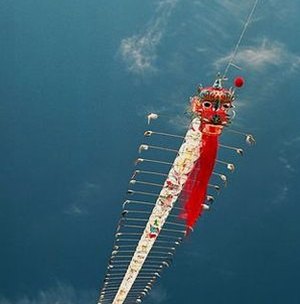 Dragon head with beard
Some centipede kites are very big and very expensive, since a lot
of labor goes into making them. Most are mid-sized but still not cheap
compared to children's kites.
Like most authentic Chinese kites, dragons can be displayed as works of art. This is particularly true for those in the centipede style, since they are so intricately made!
In flight, the head is closest to the ground. That's a good thing, since it's an impressive piece of art in its own right.
I remember seeing one of the smallest available kites of this type at an online store. Interestingly, one of the happy reviewers used it purely for decoration while the other took it out flying, with a child.
On this site, there's more kite-making info than you can poke a stick at :-)
Want to know the most convenient way of using it all?
The Big MBK E-book Bundle is a collection of downloads—printable PDF files which provide step-by-step instructions for many kites large and small.
Every kite in every MBK series.
Centipede-Style Dragons
The large centipede-style kite is an amazing thing, whether it is hanging in the foyer of a large building as a piece of art or flying with its tail pointing at the clouds.
Up close, you can see great detail in the fine bamboo framework of the head, in particular. Raw silk is used for covering, and this is precisely and painstakingly painted by hand. Being Chinese, bright red is used a lot, but plenty of other colors are used as well.
The tail sections are just a series of smaller flat kites. These are constructed from thin bamboo strips covered with raw silk and then hand painted. Each tail section has a thin bamboo rod running through it, with a feather attached to each end.
Did I mention how all the bamboo lengths that make up the framework get created? Apparently, each piece is individually bent into shape over an open flame! Then, they have to be fastened together securely. No wonder the whole process takes so long. Plus, there's the fine detail in the painting (done with a small brush) that would take some time.
The craftsmanship in these kites is just mind-boggling. No wonder it can take a team of artists up to two months to create one, using traditional techniques and tools.
If you ever buy a dragon, chances are it will come packed in an embroidered presentation box. See, even the box it comes in is "arty"!
Probably the best-known place of manufacture for these kites is Weifang, the home of traditional Chinese kite making. Kites are exported from there to locations all around the world.
How's this for a little bit of trivia... Kite teams often fly traditional Chinese centipede kites to mark the Lunar Year of the Dragon!
Flying Dragon Kites
What kind of wind does it take to fly these things? Surprisingly, just a soft breeze of 3 kph (2 mph) is enough for some of the best large dragons to stay off the ground! All those light little tail sections, all pulling together, generate a lot of lifting force. The head is just for looks.
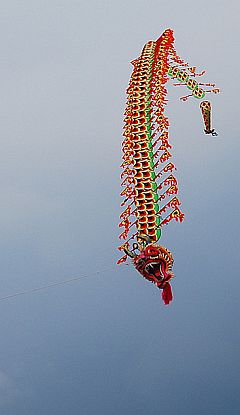 Photo courtesy of Wenna
However, you might need a decent breeze to get the smallest dragon centipede kites to fly.
Are you a kite geek? Let's talk wing loading! Painted raw silk weighs the same per unit area whether used in a small or large kite. Plus, aerodynamic performance of any flying thing gets worse on smaller scales.
What about when it's really windy? No problem. These kites can be flown in a 40 kph (25 mph) breeze, which causes the tail to rise almost vertically into the air. As you can imagine, in these conditions you need some help with a large centipede kite!
The bigger the kite, the more people are needed to keep it under control. You can also tether it to heavy machinery like a truck or something.
A flying centipede dragon is an impressive sight, with the long tail snaking skyward and tail-section feathers fluttering in the breeze. Like a live creature, the structure gently moves about on its leash.
The smallest dragon kites are pretty easy to get into the air. Just attach the bridle and hold it up for the breeze to catch the tail and take it up. The larger kites, while still easy to launch, take a bit more organization with connecting things up, laying out the tail, and so on.
Flying a traditional Chinese kite of any sort in wet weather is not a good idea. That's because hand-painted silk is not waterproof! Flying in turbulent air can also be a problem, so keep well away from buildings and trees.
Of course, as I've already mentioned, you don't have to actually fly your kite! They are genuine works of art, and many people have a dragon kite displayed somewhere in their home. That could be interesting in a one-bedroom flat though. Also, some businesses have a large dragon hung up somewhere to attract attention. It gets more people through the door I guess.
History
Here are a couple of notes on some aspects of the Chinese dragon that go back a long time.
First, nearly all authentic dragon designs have the following features:
- a "centipede" tail structure that represents a snake
- deer horns that represent long life and good luck
- catfish whiskers that represent wealth
- tigers' eyes, since the tiger is strong and rules over other animals
- a human beard that symbolizes intelligence and talent
Second, many of the dragon kites that are flown or displayed around the world today were produced by Imperial Dragon Kites of Shanghai, in China. This company is old by anyone's standards! Can you believe they have been manufacturing this kind of kite for nearly two centuries!
Other Dragon Kite Designs
OK, we've covered the two main types, but I've noticed one other type of traditional dragon kite.
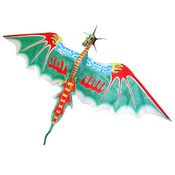 Medieval dragon
Of all the many categories of Chinese kites, there is one for hard flat kites.
This category covers all flat kites that consist of curved and straight bamboo spars covered with silk or paper. Hence, the outline of one of these kites can be complex, with some curved edges and some straight edges.
The image of a creature is painted on by hand, giving a fairly realistic impression of the creature flying through the air. In the case of an ornate oriental dragon, this results in something like the Medieval Dragon kite in the picture.
Finally, I believe there are some traditional Chinese kites which are 3D, where a little model of a creature is constructed from fine slivers of bamboo covered in silk or paper. A flat kite with straight spars is then attached to the 3D model which allows it to fly.
As mentioned earlier, there's more kite-making on this site than you can poke a stick at :-)
Want to know the most convenient way of using it all?
The Big MBK E-book Bundle is a collection of downloads—printable PDF files which provide step-by-step instructions for many kites large and small.
Every kite in every MBK series.
