- Home Page
- Accessories
- Wind Gauge
Use a Wind Gauge
Or Just Watch the Trees!
Some kite fliers find a wind gauge handy. However, if you don't have one, observing trees and leaves is a fair substitute! After a few years without one, I finally got one on the 25th December. ;-)
There it is in the photo down there. See those little spinning cups! It seems the mechanism is very accurately made and also extremely light. Operation is completely silent and vibration-free.
This device gave a new dimension to the flight reports, since I was able to quote precise numbers to accompany the hand-waving narrative!
Visitors to this site then had more accurate info on how the MBK kites
behave at various wind speeds.
Most portable wind meters fall into two categories: tubular and electronic. In this day and age, there is a very wide range of electronic models to choose from.

On this site, there's more kite-making info than you can poke a stick at. :-)
Want to know the most convenient way of using it all?
The Big MBK E-book Bundle is a collection of downloads—printable PDF files which provide step-by-step instructions for many kites large and small.
Every kite in every MBK series.
The Electronic Wind Gauge
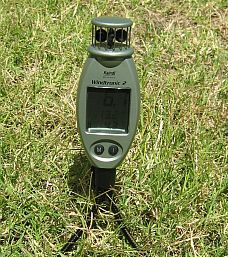
These are all the rage with a variety of wind-related outdoor sports people.
The handy little devices are used in sailing, windsurfing, paragliding, you name it.
However, these things are often far more than just meters for wind speed! Some are more like complete little weather stations, informing you of everything such as altitude, dew point, temperature, chill factor, and barometric pressure.
From a kite flier's point of view, the ability of a wind meter (or anemometer as they are also known) to monitor average speed seems like a great feature. Again, though, how do they do in extremely light conditions when your 2-Skewer Dopero is hanging up there and hardly a leaf is stirring? Surprisingly well, it turns out.
The best of these devices are able to measure reliably over quite an enormous range of wind speeds. That is, from almost nothing to 150 kph or so.
The Hall Wind Gauge
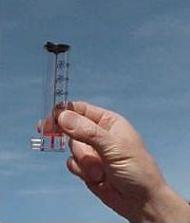
This simple mechanical device is just a clear tube with a light disk that floats up and down on a central spindle.
You just point the small air inlet into the wind and read the wind speed off the scale printed on the wall of the tube. I can remember seeing something similar in my childhood when my father used to be responsible for a small meteorological station.
Having never actually used a gauge of this type, I have to wonder how they would perform in extremely light winds. Also, you would have to guess at the average wind strength, based on the movements of the disk over a minute or so.
On the plus side, you never need to change batteries! Also, the device is so simple that with good care it should keep working forever.
Trees and Leaves as a Wind Gauge
Before getting a good wind meter I used to just go by the motion of trees and their leaves. Also, there's the sound of those leaves! This actually gives useful information over a very wide range of wind speeds. From personal experience, the following list sums up the behavior of gum trees in winds of various strengths:
- Dead calm. No motion, no sound. Duh!
- Very light. Some leaf motion, no sound.
- Light. Frequent leaf and twig motion, very little sound.
- Light-to-moderate. Small branches in motion, obvious leaf noise during gusts.
- Moderate. Larger branches in motion, constant leaf noise.
- Moderate-to-fresh More motion, more noise.
- Fresh. Most of the tree's branches are moving, with plenty of leaf noise.
That's just off the top of my head. Anything more than "fresh" isn't of much interest to most single-line kite fliers. I never did get around to doing some observations with wind gauge in hand to compile a more definitive list. It's an exercise for the reader!
Oh, there's one little complicating factor; not all trees behave the same! For example, pine needles hardly budge until the wind really picks up. At the other extreme, palms and other plants with fronds tend to be much more sensitive to wind than most suburban trees.
As mentioned earlier, there's more kite making on this site than you can poke a stick at. :-)
Want to know the most convenient way of using it all?
The Big MBK E-book Bundle is a collection of downloads—printable PDF files that provide step-by-step instructions for many kites large and small.
That's every kite in every MBK series.
