- Home Page
- Kiting Knots
- Simple Knot
The Simple Knot
Variations and Applications
Since the single-strand Simple knot is so simple, this is more about usage than how to tie it! The main use I find for it is to prevent fraying near a free end of kite line in just about any situation.
Of course, for nylon or polyester lines, there is also the old kite-maker's trick of melting the frayed end with a flame. The gas-stove lighter can come in handy for this.
This page also covers the Figure Eight knot, which is almost as easy to remember and tie as the Simple knot.
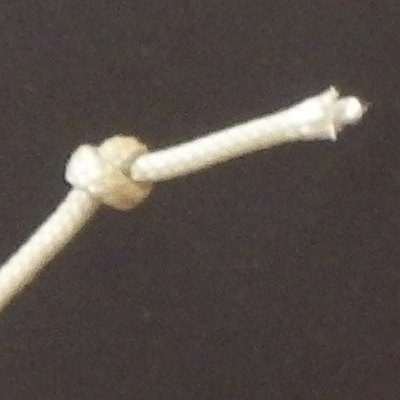 Single-strand Simple knot

On this site, there's more kite-making info than you can poke a stick at. :-)
Want to know the most convenient way of using it all?
The Big MBK E-book Bundle is a collection of downloads—printable PDF files which provide step-by-step instructions for many kites large and small.
That's every kite in every MBK series.
Simple Knot—Single Strand
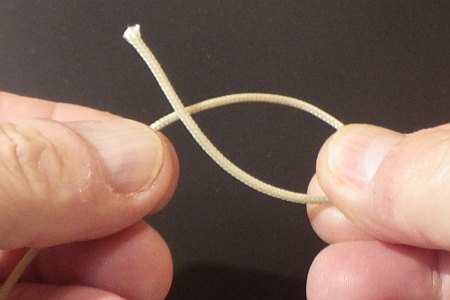 1. Around and over
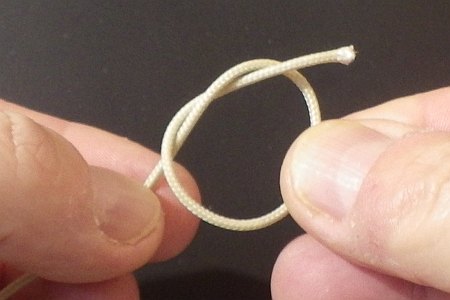 2. Around and through
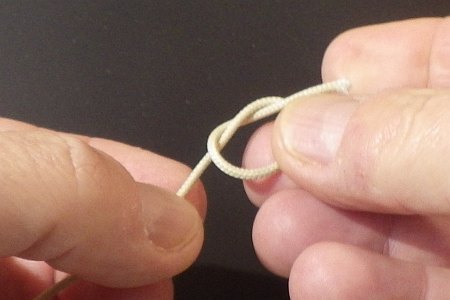 3. Adjust towards end if necc.
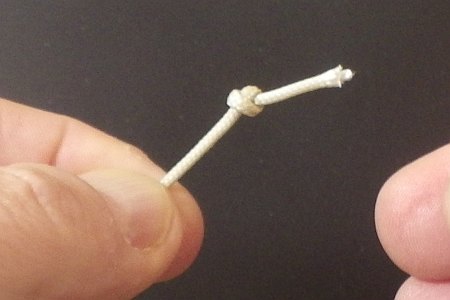 4. Pull tight
Another handy use for the Simple knot is to fine-tune the amount of bow
in a horizontal spar. Wait, I'll explain! The MBK kite designs use
fixed-length toggled bow lines to put some curvature in horizontal
spars. To increase the amount of curvature, you can put knots in
the lines—one at a time, until the amount of bow is where you like it.
Actually, it's surprising how much difference just one knot makes!
I tried using this knot to prevent Slip knots from pulling
through, but it's not really big enough. More recently, I have been using the Double knot instead, which is much bigger but far neater looking than the small Loop knots I used to use! This is OK as long as you don't leave too much line hanging free from the knot.
Oh yes, there's one more situation: The shoelace ties used by the kites in the Dowel Series fray really badly where cut with scissors. A tight knot near the cut end of the shoelace will stop the fray from getting worse—a quick, easy, and effective solution. The specified length (to make the ties) takes this shortening of the tie into account.
Simple Knot—Multi-Strand
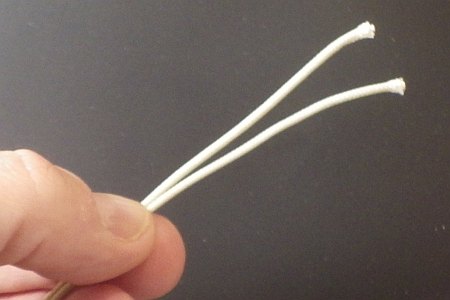 1. Ends side-by-side
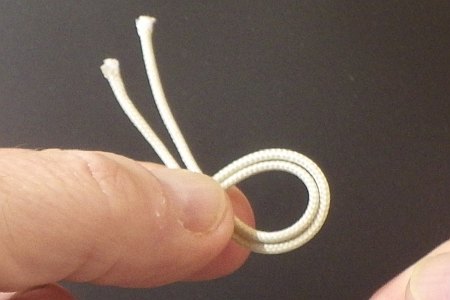 2. Around and over
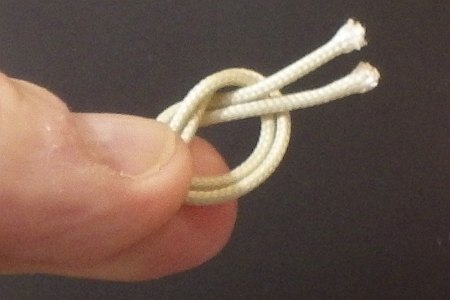 3. Around and through
 4. Pull tight
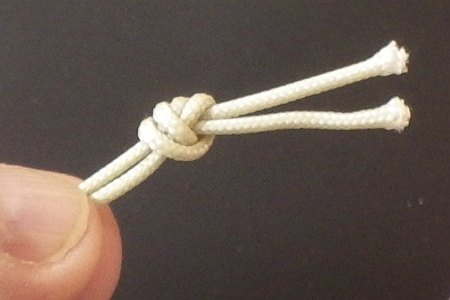
The main use for the Multi-Strand Simple knot in an MBK kite is tying off the lines that have been taped to either side of a plastic keel. The nice thing about a double-line knot is that you can adjust it to an exact position along the line before you tighten it fully. It takes some practice, but it feels good when mastered!
With a little care, this is a great knot to use along the edge of the keel that touches the vertical spar of a kite.
If the knot is adjusted too far one way, you'll crush the keel edge out of shape. If adjusted too far the other way, there will be an untidy gap between the keel edge and the vertical spar when you finally attach the keel to the spar with Granny knots.
This knot is also handy at the Towing Point corner of a keel, defining the spot through which the flying-line tension acts.
Figure Eight Knot
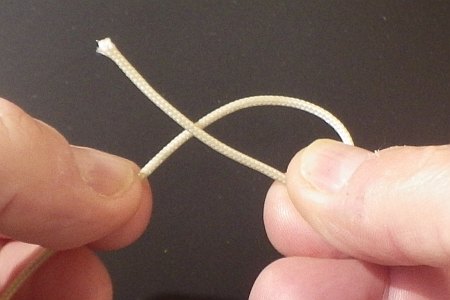 1. Around and over
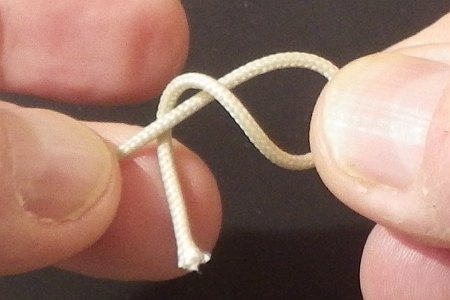 2. Around and down
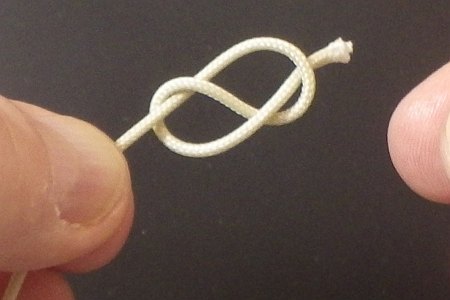 3. Over and through
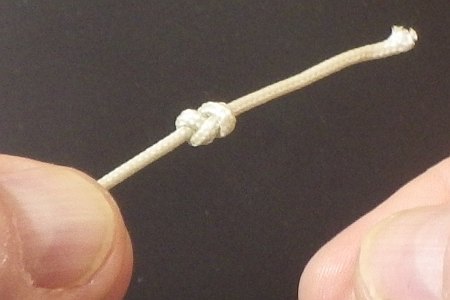 4. Pull tight
This is another knot that is useful for preventing a fray from progressing. It's also big enough to stop slip knots from pulling through. The Figure Eight is strangely attractive somehow, with its neat symmetrical look and how the line comes out in the same direction as it went in!
This knot can also be found acting as a stopper, preventing attached lines or objects from slipping along any further.
As mentioned earlier, there's more kite making on this site than you can poke a stick at. :-)
Want to know the most convenient way of using it all?
The Big MBK E-book Bundle is a collection of downloads—printable PDF files which provide step-by-step instructions for many kites large and small.
That's every kite in every MBK series.
