- Home Page
- Popular Kites
- Rokkaku Kite
The Rokkaku Kite
Some Background
The rokkaku kite is a traditional Japanese fighting kite that in the 21st century is still quite popular in the West as well. The rok, as it's often referred to in the West, is a tailless bowed design, hexagonal in shape.
 MBK Dowel Rokkaku
Although there are differences between East and West, rok battles involving individuals or teams are still being organized in various parts of the world.
In Japan, the kites are often large and made from traditional construction materials. We were fortunate enough to see a few examples of the real thing at a kite festival here in Adelaide one year.
Talking about that kite festival ... for several years, a
collection of identical small white rokkakus were pulled out each year
for a crowd-pleasing item—the Rokkaku Challenge! One year, I captured
an entire bout on video. The soundtrack also captured the running
commentary coming through the PA.
In the USA there is also a thriving rok-battle scene with its own rules and kites made from more modern materials.
The last kite remaining in the air wins! Strings are either sawn through, or kites tangle and come to ground together.
On this site, there's more kite-making info than you can poke a stick at :-)
Want to know the most convenient way of using it all?
The Big MBK E-book Bundle is a collection of downloads—printable PDF files which provide step-by-step instructions for many kites large and small.
Every kite in every MBK series.
Here's an interesting little snippet I picked up. Have you heard it said that the delta is the easiest type of kite to fly, hence good for beginners?
I heard it myself once, over the PA system at a big festival! Well, the whisper is ... once someone owns a rokkaku kite, they never go back to a delta!
The frame of a rokkaku kite looks similar in shape regardless of the overall size. The thickness and strength of the spars are just scaled up or down depending on how big the kite is. Most roks are just under 2 meters (6 feet) in height, since this is the most common size in a kite battle. My little 29 cm (11 1/2 in.) 1-Skewer Rokkaku is very much the exception!
Here's some of the variations, or lack thereof, in roks you might see flying today:
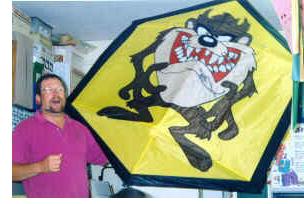 Rok featuring applique decoration
- The overall size of both traditional and Western rok-inspired kites doesn't vary a whole lot, in general.
- The basic outline is always the same, with minor variations in proportions.
- Traditional construction materials hardly vary at all, which contrasts with the variety of modern kite-making materials.
- Traditional rokkakus are designed to fly without a tail in all conditions.
- Traditional roks are artistically decorated and shop-bought versions are available in very vivid modern designs.
- The number of bridle legs varies, with four being by far the most common number.
- Traditionally, the sail was hand-made paper but these days ripstop nylon is commonly used.
Here's a few comments on each of the above points:
Size. Most plans and write-ups for rokkaku kites feature a vertical spar around 1.8 meters (6 feet) long. This is because the most commonly accepted size for Rok Battle kites is 6 feet. Kites bought from stores vary a bit more with one well-known shop selling sizes from 1.2 meters (4 feet) tall through to 2 meters (6 feet) tall. There's that 6-foot measurement again! There also seems to be the occasional bigger home-made rokkaku kite, say 7 or 8 feet tall, flown for recreation. And of course, the kite aerial photography (KAP) crowd have always loved their super-big stable roks!
Shape. Rokkaku kites all look pretty much the same in outline, with six corners, a long vertical spar, and two bowed cross-spars. There are two widely-used proportions in particular, named 4,5,6 and 3,4,5. For example, 3,4,5 means that the kite is 5 units tall, 4 units wide, and the main body—the rectangular bit—is 3 units tall. That means the cross spars are 1 unit in from the top and bottom.
Construction. The Japanese like to refer to the kite frame as the "bones" and the sail material as the "skin"—sounds logical to me! A modern rokkaku kite might have pockets in the sail, into which the ends of the spars are inserted. Then the cross spars are bowed, and the kite is ready for flight. There's not much to it really; it's a small price for having something collapsible and easily transportable. Browsing around, I came across three separate methods for holding a bow in a cross spar:
- The truckie's knot: Without going into detail, this is an easy way to hold tension in the line while tying it off at one end of the cross spar.
- Using one line from each end of the cross spar: A button on one and loop on the other allow the lines to be connected in the middle and hence hold the tension.
- Using a slider with three holes: With a slight twist, the line moves easily through the slider, but let it go and it holds the tension firmly. One end of the line is tied off at the third hole, after passing around one spar end.
One clever idea used by some designs is where the vertical spar remains attached to the cross spars. However, it separates in the middle, so each section can be swung around parallel to the cross spar to which it is attached. In this state, the whole thing can just be rolled up like a mat. Easy.
Being able to alter the amount of bow easily, as with the three-holed slider, is handy. This way, the stability of the kite can be tweaked to suit the conditions.
Tails. Usually, roks are flown without tails. However, a tail can be useful in strong winds. People who suspend expensive cameras from their kite line are particularly keen to have the kite good and stable in strong winds!
Decoration. Firstly, some modern methods could be mentioned. Strips of different-colored material can be joined together before the outline is cut. The appliqué technique involves sticking light but colorful cutout patterns onto the sail material. Screen-printed sail material can be used. These methods can be seen in both shop bought and homemade kites. Nearly all traditional Japanese kites were brush painted with bright-colored natural dyes and black ink. The shape of the rokkaku kite really lends itself to displaying a face of some sort. I've seen everything from people to eagles' heads!
Bridle. When it comes to bridles, there is some variation. Generally, a four-leg bridle is sufficient for the standard 2 meter (6 foot) rok. The bridle lines attach to the cross spars, midway between the vertical spar and the edge of the kite. Kites this size or larger can benefit from an extra one, two, or even three bridle lines attached to the vertical spar. This helps the spars resist bending out of shape in strong winds.
Sail. A traditional rokkaku kite used washi paper that was hand made. These days, ripstop nylon or Tyvek is a common choice for the larger kites. Smaller kites made in workshop sessions often just use plastic or tissue paper.
Like to see a video clip? Just scroll down to near the end of this page.
Rokkaku Kites in Action
Even more so than a large diamond, the rokkaku kite is pretty versatile. Roks are used for
- kite battles, oh yes!
- hoisting line laundry such as spinners and inflatables
- KAP in a large range of wind speeds
- other lifting tasks, such as atmospheric measuring equipment
- kite rescue—that was a new one on me too!
The rokkaku kite battle originated in Japan, like the kite itself. In the West, these competitions are organized for either individuals or teams. The idea is to force your opponent's kite to the ground. Here are the three methods used:
- Cutting—by slicing through another flying line with your own, similar to an Indian fighter kite battle
- Tipping—by upsetting another kite with your own flying line, causing the other kite to touch the ground (takes a bit of skill)
- Wind blocking—managing to stay in the air while others run out of flying room and end up on the ground (sneaky!)
It's not uncommon to see a rok battle at a kite festival. It sounds like a lot of fun!
Out in the Field
Rokkaku-kite stories of my real-life flying experiences are worth checking out!
Illustrated with photos and videos, of course.
With their strong lifting ability and stable flying characteristics, it's no wonder some people use a rokkaku kite for hanging out their line laundry. You know, spinners, streamers, even inflatable creations that float and dance in the wind. If you've been to a kite festival you would have seen this kind of thing for sure. Airborne line-laundry makes good subject matter for KAPers too.
Talking about kite aerial photography (KAP), the largest rokkakus are sometimes used for lifting camera rigs. My guess (in 2007) is that as digital cameras get better and lighter in future, these guys won't need such huge kites to get great images! We'll see.
Here's a delightful picture of a decent-sized rokkaku kite:
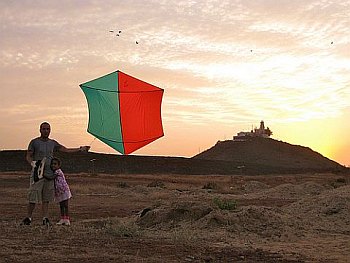 Photo courtesy of Jeff Attaway.
Now here's an interesting lifting application. Some guys working for the Institute for Marine and Atmospheric Research Utrecht (I.M.A.U.) have used a couple of roks for scientific purposes, way down in Antarctica. Due to the extreme cold, these kites were specially designed to be rigged while the flyer is wearing thick gloves. Their 2 meter (6 foot) and 1.5 meter (5 foot) roks were used separately or stacked together, to provide the required lifting force in a variety of wind conditions. The payload was atmospheric measuring equipment, hoisted to the considerable height of 600 meters (2000 feet).
Did you know that kites have been rescued from trees by other kites? Neither did I until very recently! Kite rescue is done, I presume, by flying under the flying line of the stuck kite. If the lines cross fairly close to the tree, I can imagine how there would be a good chance of lifting it out of the branches and leaves. How about that.
Some Rokkaku Kite History
At this point, I haven't yet waded through any big books on Japanese kite history, so I haven't got much specifically on the rokkaku kite. However, there are a few snippets I can share with you.
Most artistic Japanese kites were developed in the Edo period from 1603 to 1867. At this time, Japan was closed to foreigners. Different designs originated from different regions of the country, including, presumably, the rokkaku. Since the earliest times, some roks have been adorned with the faces of heroes from Japanese folklore. In 1649, the Sanjo Rokkaku fighting-kite festival began at Niigata Prefecture in Japan.
There is actually a Rokkakudo Temple located in central Kyoto. Since the rokkaku
part of the name refers to the hexagonal shape of the temple, there
seems to be some connection. Only historians would know which came first—the kite or the temple! Sanjo is a location in Kyoto Prefecture,
hence the traditional name, the Sanjo Rokkaku.
It's not hard to make a simple rok, like our MBK Dowel Rokkaku in the video up there.
As mentioned earlier, there's more kite-making on this site than you can poke a stick at :-)
Want to know the most convenient way of using it all?
The Big MBK E-book Bundle is a collection of downloads—printable PDF files which provide step-by-step instructions for many kites large and small.
Every kite in every MBK series.
