| |
How To Build A Delta Kite
Complete Instructions For The MBK 2-Skewer Delta Kite
This set of instructions on how to build a delta kite assumes you know absolutely nothing about kite making. You might already have some of the simple tools and materials required. Anything you don't have is easily bought. If not exactly what I used, then at least something pretty similar! The instructions on how to make a delta kite might look awfully long, but that's because they are so detailed. For those who like pictures, every detail is illustrated with photographs too. Just quickly work your way through, skimming over any detail that you don't need. All in all, it should be quite hard to make a mistake! The MBK 2-Skewer Delta Kite is a medium-sized delta 96 cm across and 58 cm tall, with a single tail. The spreader is bowed to give extra stability and shorten the amount of tail required. Hence it's a bit different to a store-bought delta! The 2-Skewer Delta is a very nice light-to-moderate wind flier. Watch it go straight overhead when a thermal comes through! However, like other deltas it's not too stable in fresh winds. Have you read the page on kite materials? If you haven't already, do it now to see what's needed for building a delta kite.
How To Build A Delta Kite - Frame
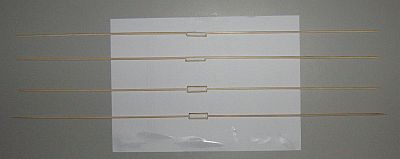
For this delta, you need to glue skewers together to form the 3 spars plus spreader. - Snip the points off 6 bamboo skewers, then check to see that they are all exactly the same length - trim some if necessary
- Put aside another 2 skewers, leaving the points on for now
- From another skewer, snip off 6 lengths of bamboo, each 0.1 x (one skewer length) long
- Arrange all 8 skewers together with the short lengths as in the photo, with some paper underneath to catch excess glue - tape that paper down to the table
- Get down to table top height and look along the spars, and make sure they are as straight as possible
- Lay down a thick line of glue all the way down each join, as in the photo
How To Build A Delta Kite - Sail
The template shown above represents one side of the kite sail. You will now transfer these measurements to the sail plastic as follows... 
The shape of the delta means that it is not practical to just lay down some spars and mark the corners that way, as with some other simpler MBK kites. So, for most dots, you need to multiply each measurement by your Skewer Length to get the required distance. For example, for my skewers which are 29 c.m. long, 0.1SL equals 0.1 x 29 = 2.9 c.m. You might be working in inches, and using a Skewer Length of say 12 inches, so that would be 0.1 x 12 = 1 2/10 inches. Note: I've made the dots much bigger than they need to be, just so they show up easily in the photo. By the way, there should be a dot on the center-line, right near the bottom - but the photo cuts it off. - Firstly, mark the the top dot on the center line, then lay the vertical spar down beside the plastic and mark the bottom dot
- Measure 1.25SL down from the top dot and mark the middle dot
- Next, mark each end of the fold-line plus the mark which is part-way along the trailing edge, as in the photo - judging the 90 degree angle by eye is quite OK since any small error will be exactly the same on the other side
- Lay a leading-edge spar over the fold-line, and shift the lower dot a little if necessary, so the fold line is exactly the same length as the bamboo spar
- Next, mark the 2 corners of the long narrow flap along the leading edge - after seeing what 0.05SL looks like, just put these dots in by eye
- Finally, rule lines between the marks, as in the photo

- Flip the plastic bag over, and trace over all the black lines using your marker pen and ruler
- Cut out a roughly rectangular section of the bag containing the kite sail, open it out and lay it flat on the table - you can now see the complete sail outline, as in the photo

- Lay a piece of clear sticking tape along the short nose section with the line showing through the center of the tape - but avoid getting any tape on the fold-line
- Lay 4 pieces of clear sticking tape along the trailing edge, with each line showing through the center of the tape - again, avoiding the fold-line
- With scissors, cut all around the sail outline

Is the glue on all the bamboo spars dry? If so ... - Place the leading edge spars, the ones with just one short reinforcer, over the fold lines - with the reinforcers facing the center-line
- Lay one of the remaining spars over the 2 leading edge spars, so it crosses them at the top end of the 2 reinforcers - this will be the spreader
- Making sure the spreader is centered over the sail center-line, make marks where it crosses the leading edge spars
- Next, snip off the ends of the spreader, at those marks
- Re-check the fit, since you will probably have to snip a few more times to get it just right - the tips tuck neatly in, with the spreader lying flat against the table
- When it all looks good, drip on some wood glue, as in the photo
Now wait for this to dry!

The black pieces of electrical tape mentioned below should all be roughly 3 times longer than they are wide. You can't see the full length in the photo since they are folded under. - Place the remaining spar over the center line of the sail, and underneath the spreader - this is the vertical spar
- Secure the upper end of the vertical spar to the sail with a piece of electrical tape, wrapping it under to the other side of the sail
- Secure the lower end of the vertical spar to the sail with a similar piece of electrical tape, wrapping it under to the other side of the sail as before - gently pull any slackness out of the sail as you do this
- Next, fold the sail over the leading edge spars and cap the tips with black tape, as in the photo - the tape should be folded around the tip of the spar so it can't slip through the plastic
- Add more tape like the yellow pieces in the photo - right over top of the short reinforcers
- Add 4 long pieces of clear sticky tape to complete the taping down of the sail near the leading edges of the kite
- Secure the spreader to the vertical spar, using drops of glue where they cross
- If you want to, trim any bits of tape that stick out, with scissors
How To Build A Delta Kite - The Keel
- Mark out a triangle on some spare plastic, as per the dimensions on the template
- Cut out the triangle and tape down 2 lengths of flying line onto one side, as visible in the photo - use sticky tape, not electrical tape
- Now flip the plastic over and tape down another 2 lengths of flying line, directly over the first 2
- Also lay down tape along the remaining edge of the keel, on both sides of the plastic
- Reinforce the keel by sticking down and wrapping extra bits of tape where the pieces of line come out, making sure the plastic remains flat
- Where the 4 pieces of line come together, tie a knot close to the plastic, then tie another one further out, as in the photo

- Using a spare skewer, poke 2 holes in the plastic sail 0.55SL from the nose of the kite - 1 hole on either side of the vertical spar
- Thread the upper keel lines through and tie off tightly
- Poke the bottom 2 holes in the plastic, using the keel itself to find the exact spot, thread the lower lines through and tie off tightly
- With the keel flat against the plastic sail, add sticky tape between the knots, attaching the keel to the sail plastic - then flip the keel over and do the other side

Now take a length of flying line about half a skewer long, and tie one end to the bridle line with a Prussik knot. Tie a small simple overhand loop into the other end, just to get a nice big knot.
How To Build A Delta Kite - Attaching The Tail
Have you read the page on making kite tails? Assuming you have... - Make up a tail from a black garbage bag, making sure it is at least 3 times as long as the delta kite itself
- Attach the tail by poking one end between the bottom of the vertical spar and the sail plastic
- Pull the rest of the tail through the loop, but don't over-tighten - see the photo
How To Build A Delta Kite - Bow The Spreader
- Cut off a piece of flying line about 1 skewer length long, and another one about 2 skewer lengths long
- Tie the lines to the spar and pass the longer line through the 2 loops - see the photo below
- Put a bow into the spreader, securing the truckie's knot with a couple of half hitches - each tip of the spreader should be at least 0.1SL above the table top
- Put a drop of glue on both the knots that have been tied against the bamboo - they must never come loose!
Hint: To stop the knots slipping along the bamboo, it helps to prop up one end of the spreader to 0.2SL and weigh down the middle of the spreader with a heavy object, before gently tightening the line. As in the photo above! Leave until the glue is dry. 
At this point, you've pretty much finished making the 2-Skewer Delta!
How To Build A Delta Kite - Preparing To Fly
Finally, make up a flying line and attach it to the bridle with a Lark's Head knot. See the photo above, which shows the knot before it has been pulled tight.
How To Build A Delta Kite - Flying!Assuming there is some breeze outside, just dangle the kite at arm's length until the wind catches it. As long as you feel the kite pulling, let out line slowly by letting it slip through your fingers. Another way to launch is to get a helper to hold the kite up and let it go, with maybe 10 or 20 meters of line let out. This way, the kite soon gets high enough to make it easy to let more line out. You could also try pulling it along the grass, with the keel on the bottom of course, until the kite pops into the air and climbs away. 
Here's a picture of the MBK 2-Skewer Delta Kite, being brought down after its first test flight. The kite touched 50 meters altitude on a 50 meter line. Yes, it soars nicely on small patches of rising air! Have fun flying, and I hope you've enjoyed learning how to build a Delta kite. Remember, once you get it in the air, you've joined the MBK Kite Club! All the above info, plus much more is available in a PDF eBook which covers the entire 2-skewer series of kites.
Subscribe to the MBK Flying Skewers And Plastic newsletter for fresh instructions each month for a new type of skewer kite to make. Have fun making this kite with your kids, or just for your own enjoyment!
Last updated: 15 Sep 2008
Return to How To Make A Kite from How To Build A Delta Kite
All the way back to Home Page

|