- Home Page
- Popular Kites
- Eddy Kite
The Eddy Kite
Some History and Personal Experience
Firstly, what exactly is an Eddy kite? The original design was a large diamond-shaped kite from the 1800s which flew without a tail.
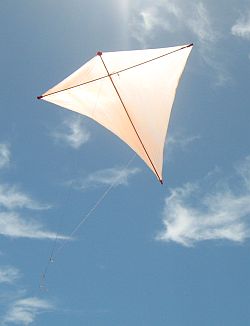 Original Dowel Diamond
Unlike the historical Eddy, most retail diamonds these days are tailed. Most also have some dihedral or bow in the horizontal spar. This greatly helps stability and enables the use of shorter tails.
This little list sums up the historical Eddy:
- Invented by William A. Eddy in the 1890s, and inspired by ancient Javanese bowed kites. More commonly known as the "Malay."
- Diamond shaped, as already mentioned, using spruce spars.
- Sail edges attached to wire perimeter lines.
- Bowed horizontal spar, attached to the vertical spar 19% of the way down from the nose.
- Loose-fitting cotton sail which billowed at the tail end, forming a small keel.
- No tail—very handy for kite trains, since tails tend to get wrapped around the flying line!
- Two-leg bridle, one attachment point being where the spars cross, the other at the extreme tail-end.
On this site, there's more kite-making info than you can poke a stick at :-)
Want to know the most convenient way of using it all?
The Big MBK E-book Bundle is a collection of downloads—printable PDF files which provide step-by-step instructions for many kites large and small.
Every kite in every MBK series.
Our MBK Dowel Series of kites are all tailless, like the Eddy-inspired Dowel Diamond. That's an old version of it in the first photo on this page.
However, we have made some minor changes in a later version. They both fly beautifully in very light wind.
I remember on one occasion in the late afternoon, this kite floated right up to 400 feet, going almost overhead. At the time, there was barely a breath of wind at ground level!
In case you are curious about Eddy himself, here are a few interesting details:
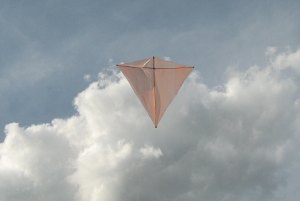 MBK Dowel Diamond
- His full name was William A. Eddy.
- He was from New Jersey, USA, and worked as a journalist.
- Eddy developed his efficient stable diamond-shaped kite in the 1890s.
- He began his kite flying with the classic American barn-door design—hexagonal kites that sometimes had a coffin-like shape.
- Eddy was inspired by the tailless bowed Malay design, since his kite trains kept getting into trouble with tangled tails!
- Eddy was famous for his kite-powered aerial photography and also meteorological experiments. These were carried out at the Blue Hill Observatory, near Boston, USA.
In some circles, the term Eddy is used more loosely to mean just about any kind of diamond kite. I first became aware of this when a European blogger featured my MBK 1-Skewer Diamond design in a post. A "little Eddy" he called it!
Why Make an Eddy Kite?
For a start, you won't find many truly Eddy-like designs in the shops. Tailed diamonds are the closest thing offered both online and offline. However, a good reason to make one is that the design is quite easy to build and results in a stable efficient kite.
For some additional fun, you can stack these kites together along one long flying line. An Eddy is a great light-to-moderate-wind flyer.
The Eddy kite was the inspiration for my original Dowel Diamond design, which you can see in the first photo on this page. It's hard to spot in the photo, but it had a two-leg bridle.
From a distance, the Dowel Diamond and
the Eddy look very similar, but there are in fact a few
differences. The Dowel Series kite has a plastic
sail and tape edging. It's shape is quite close to Eddy's original,
although the overall size is somewhat smaller. Some of the originals
were almost 3 meters (9 feet) in height!
It's relaxing seeing the Dowel Diamond hang up there in a light
breeze. Having a three-leg bridle, my most recent version doesn't waggle its wingtips like an authentic Eddy
kite would do. See the video below. With a sliding knot on the bridle,
it can be adjusted toward the nose a little if the breeze is stronger
and threatening to overpower the kite. The 1.2-meter (4-foot) span sail
generates a decent pull and can keep the line fairly straight, even with
over 100 meters (330 feet) let out.
There's our MBK Dowel Diamond in flight, above.
Modern Versions of the Eddy Kite
It seems Eddy kites are everywhere. Some are bowed, while some are made with dihedral. People like to make them very colorful too, unlike yours truly who has stuck with pale orange for three series of eight kites each! Going overboard with decoration can turn even an Eddy into a lumbering moderate-wind kite though.
Sizes vary a lot too, with quite small versions being made for children and other enthusiasts tackling full 9-foot replicas of the original meteorological kites!
An interesting but simple variation of the Eddy kite is the
single-point-bridle diamond. The flying line simply attaches to where
the spars cross. The crossing point is 25% from the nose rather than the
original 19% for these.
With sufficient bow and slightly slack sail these kites can still fly tailless, and therefore are perfect for flying in a stack or train.
As mentioned earlier, there's more kite making on this site than you can poke a stick at. :-)
Want to know the most convenient way of using it all?
The Big MBK E-book Bundle is a collection of downloads—printable PDF files that provide step-by-step instructions for many kites large and small.
That's every kite in every MBK series.
