- Home Page
- Popular Kites
- Diamond Kites
Diamond Kites
Iconic and Ever Reliable!
Diamond kites have been around for a long time—centuries, in fact!
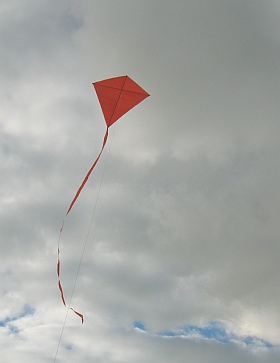 Our Simple Diamond wobbles up
Why do diamonds continue to be popular? If you have ever slapped one together and successfully flown it in light or moderate breezes, then it's obvious. With a long enough tail, it doesn't take a lot of skill to make a diamond that flies reasonably well. Hence the success rate is pretty high.
Shops have had no trouble selling nicely constructed
and decorated kites in the diamond shape for decades. People are just
drawn to the familiar diamond shape.
The simplest kind of diamond is just a set of two crossed sticks of equal length, attached to a diamond-shaped sail. With the crossing point set at 25 percent down from the nose, the kite does not even require a bridle. The flying line can simply be attached directly to where the sticks cross.
In fact, this is exactly how our MBK Simple Diamond is made. See it there in the photo!
We've been to a few kite festivals over the years and taken plenty of photos. However, festival fliers tend to avoid the diamond, since it is so "been there done that"! Never mind; from the 100s of images we have, I did manage to spot three examples, which are displayed further down this page.
On this site, there's more kite-making info than you can poke a stick at. :-)
Want to know the most convenient way of using it all?
The Big MBK E-book Bundle is a collection of downloads—printable PDF files which provide step-by-step instructions for many kites large and small.
Every kite in every MBK series.
Diamond Kites We've Seen
Here are three photos of diamonds, all of which feature streamer tails. That's an indication of how popular this quick-and-easy style of tail has become! The classic line-and-bows type of tail is not often seen nowadays. Perhaps a couple of exceptions are images in children's books and TV shows!
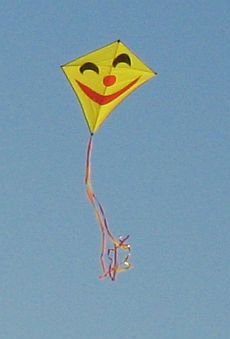 Smiley diamond
This yellow diamond really sums up the modern role of the diamond-shape kite. Fun, fun, fun! It's a simple, fool-proof kite for the young or young at heart. If I remember correctly, this one was actually flying with all the other kites on the registered-kite-fliers side of the jetty.
Most diamonds at the Adelaide festival tend to be smaller and flown from the public-flying area. The smiley-face idea is often used on simple flat kites to good effect.
Streamers form the tail. There's no simpler way, apart from using just one longer streamer.
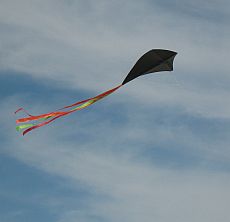 Black can be eye-catching
This black-colored design was easily spotted against the blue sky. In fact, I think black kites always photograph well in all kinds of weather.
Black stands out so well against brilliant light sky-blue or white clouds or anything in between, it seems. Plus a totally black kite just projects a different image to anything more colorful. Perhaps it's more masculine, not to mention appealing to an older age group.
The streamer tails are colored, though. Wouldn't it be a bit boring if they were all black.
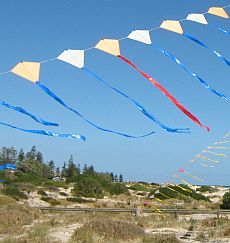 Part of a long diamond arch
Any fairly simple flat kite design lends itself to being arranged in an arch. Here's an impressive example of small diamond-shaped kites all arranged along a long line. It must have been at least 30, maybe 50 meters (160 feet) long. This arch was self-launching, so from time to time the kites just lay there on the dunes when the wind died down.
See if you can spot the far end of the arch in the photo. Also, there's some kite shadows on the sand. As usual, every little diamond has a streamer tail.
That's our big MBK Multi-Dowel Diamond in flight, above.
As mentioned earlier, there's more kite making on this site than you can poke a stick at. :-)
Want to know the most convenient way of using it all?
The Big MBK E-book Bundle is a collection of downloads—printable PDF files that provide step-by-step instructions for many kites large and small.
That's every kite in every MBK series.
