- Home Page
- Accessories
- Dacron
Dacron
Info for Fliers Plus a Short History
The staff at any kite shop will tell you that Dacron (a trade name for a type of polyester) is ideal for flying single-line kites. Compared to cotton and nylon lines of the same strength, it is lighter and thinner. Also, its high melting point means that it resists abrasion. That's handy for if you get in a tangle with someone else's flying line!
Flying line advertised as "polyester" has very similar properties.
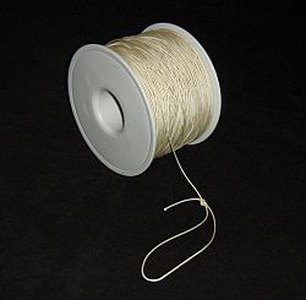 Some Dacron as delivered
There is some stretch in the material, but this is of no real concern when flying a single-line kite. If you ask me, there's nothing wrong with a bit of shock absorption in gusty winds!
Our own experiences with small Skewer Series kites on 20-pound line and larger Dowel Series kites on 50-pound line were very good.
The kites flew high with much less sag than a line made of cheaper material would have. Mind you, sharing a single flying-line among several kites makes the cost seem more reasonable!
The occasional tangles did still happen, but for us it was mainly due to carelessness.
You know, you're in a hurry winding up the line and you don't take enough notice of some resistance.
Next thing you know, a small pile of loose line has arrived at your hand in the form of a tangle! Usually, it's still fairly loose and it only takes a few minutes to sort out.
On this site, there's more kite-making info than you can poke a stick at. :-)
Want to know the most convenient way of using it all?
The Big MBK E-book Bundle is a collection of downloads—printable PDF files which provide step-by-step instructions for many kites large and small.
Every kite in every MBK series.
We flew most of our MBK kites on braided Dacron. The only exceptions were the Paper Series and Indoor Series designs that fly on polyester sewing-thread. :-)
The History of Dacron
To make it more digestible, how about a list! Here we go:
- The 1929 writings of Wallace Carothers about polymers led to the discovery of polyesters.
- Carothers invented Neoprene in 1930 and Nylon in 1935. The latter material has since become so common that "nylon" (note the lowercase n) is now a generic term.
- Two British chemists, J. R. Whinfield and J. T. Dickinson, were inspired by the work of Carothers.
- Whinfield and Dickinson invented a new high-melting-point polyester in 1941. They called it Terylene.
- ICI patented the Terylene polyester.
- DuPont purchased the US rights to Terylene in 1945 for further development.
- With modified nylon technology, a DuPont pilot plant in Seaford, Delaware produced a version of Terylene they called Dacron fiber.
- DuPont moved to mass production in its huge Kinston, North Carolina, plant in 1953.
- "The rest, as they say, is history." Yeah, I know, that's a tired old cliche.
You could spend 30 minutes or so wandering the Web to find all the above info in several places, often buried in long paragraphs. But I suspect you would rather just glance at the list to take it all in, in under half a minute!
There's my roll of 200-pound braided flying line up there in the photo—in its natural color.
Some Technical Facts
A long paragraph of technical data would be hard going, so here's another list:
- The scientific name for this material is polyethylene terephthalate.
- It's a condensation polymer obtained from ethylene glycol and terephthalic acid.
- The molecules are very long linear chains that cross link to each other.
- Each linear chain consists of 10 carbon atoms, 8 hydrogen atoms, and 4 oxygen atoms in a group. This is repeated many times, giving the chain its long length.
- The melting point of Dacron is a high 256 degrees Celsius (496 degrees Fahrenheit).
Finally, here's a not-so-technical fact... There are more uses these days for this synthetic fiber than you could poke a stick at! In my view, by far the most important one is for tethering single-line kites to terra firma. ;-)
As mentioned earlier, there's more kite making on this site than you can poke a stick at. :-)
Want to know the most convenient way of using it all?
The Big MBK E-book Bundle is a collection of downloads—printable PDF files that provide step-by-step instructions for many kites large and small.
That's every kite in every MBK series.
