- Home Page
- Kite Plans
- Roller Kites
Flying Roller Kites
Ours are DIY, in Three Sizes!
Making small roller kites from bamboo BBQ skewers and plastic bags is really dirt cheap. The dowel for making larger rollers does cost a few dollars, but still still works out to be very economical compared to buying a quality kite from a shop. I have nothing against such retail rollers, but going the DIY route certainly has its rewards! Read on below to find out a little more about our three roller designs which you can make for yourself.
Our little 1-Skewer Roller design requires a tail, but is then a good light-to-moderate-wind flyer. We made just one prototype of this design, in clear plastic, and it was reliable after trimming it to fly straight.
Next up in size comes the 2-Skewer Roller, which does well in light winds without requiring a tail. However, on the first outing with the prototype, I had to resort to putting a slight bend in the vertical spar to correct a tendency to turn! Skewers straight from the supermarket packet are rarely perfectly straight. The kite has flown very well ever since that day.
Finally, we started making larger kites like the Dowel Roller. This kite can cope with a reasonable wind range, from light to almost fresh. Getting it stable was something of a saga, until a small amount of weight at the extreme tail end finally did the trick! Ever since, this kite has been a pleasure to fly, as you will see from the flight reports on it.
Down below is a photo or two and a video of all the MBK Roller kites. This illustrates the end result, in case you decide to use our instructions to make one of these kites.
On this site, there's more kite-making info than you can poke a stick at :-)
Want to know the most convenient way of using it all?
The Big MBK E-book Bundle is a collection of downloads — printable PDF files which provide step-by-step instructions for many kites large and small.
Every kite in every MBK series.
1-Skewer Roller Kite
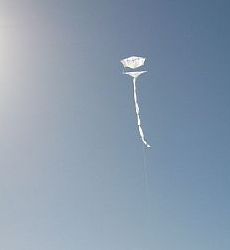 Original 1-Skewer Roller
This dinky little number is called the 1-Skewer Roller. It's the smallest of all our roller kites. Technically, it's a magnum-scale miniature! Each spar is a 29 cm (11 1/2 in.) bamboo BBQ skewer.
The original was made from clear freezer-bag plastic, which made it almost impossible to see against a gray sky. It's a good reliable flyer in light-to-moderate winds. It just has a simple two-leg bridle. Newly made, the kite is likely to turn slightly in one direction or the other. One way to correct this is to pull one of the upper sail ties through a little, to slacken off one of the sail corners.
If the kite turns to the left, you slacken off the right sail corner to compensate. When you get it right, the kite will soar straight up from then on.
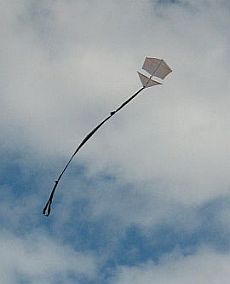 MBK 1-Skewer Roller
We flew this tiny roller on 50 meters (150 feet) of 20-pound line. It doesn't need that strength, but we also flew our 2-Skewer kites on the same line.
The clear plastic roller was eventually replaced with a slightly redesigned version in light-orange plastic. It still required a fair length of tail, so we used a long ribbon of black garbage-bag plastic to contrast with the orange sail.
This color combination is much more visible, even against gray cloud.
Here's a video of the MBK 1-Skewer Roller in the air, soaring around in an ample breeze:
2-Skewer Roller Kite
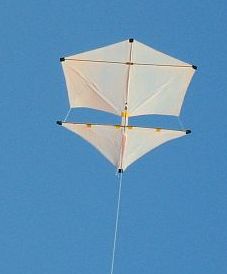 MBK 2-Skewer Roller
The 2-Skewer Roller is, as the name suggests, exactly twice as tall as the 1-Skewer design. This gives it four times the sail area with not much more than double the weight. Hence, it's pretty good in light winds. The kite pictured is the original referred to earlier, which needed that on-field tweak to the vertical spar.
The kite looked pretty good and even when viewed from the top or bottom. However, looking straight down the vertical spar uncovered the problem; both skewers had just a slight curve down their length, which effectively steered the kite to one side.
By putting a kink in the middle in the opposite direction, the turning tendency was eliminated. Yay! I still remember the relief when the kite suddenly started to fly perfectly straight in climbs. There was no need to touch those upper sail tethers either.
The video below was taken when the breeze turned out to be too light for another kite. It was no problem though, for the bamboo skewers and very light plastic sheet of the roller!
Dowel Roller Kite
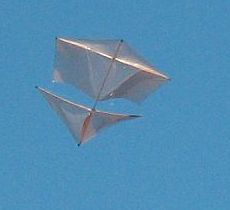 MBK Dowel Roller
Now for the largest of the MBK Roller kites. This one was designed from the start to be tailless. The Dowel Roller is an attractive kite that is a reliable flyer over a good wind range. The line angles in smooth constant wind are modest, much like a diamond or barn door.
Size? It's about twice as tall as the 2-Skewer Roller, so that's about four times the sail area. Compared to the 1-Skewer version, the Dowel Roller has about 16 times as much sail area!
The video below shows the MBK Dowel Roller on a very short line. The kite is handling the light breeze coming through some trees upwind pretty well, just managing to stay clear of the ground. This was done just to get a crisp closeup inflight video. The kite is usually flown a few hundred feet higher up :-)
That's about it for this page on our roller kites—in three convenient sizes!
I hope you enjoyed the pics and the info.
As mentioned earlier, there's more kite making on this site than you can poke a stick at :-)
Want to know the most convenient way of using it all?
The Big MBK E-book Bundle is a collection of downloads — printable PDF files which provide step-by-step instructions for many kites large and small.
Every kite in every MBK series.
