- Home Page
- Better Kites
- ... Rokkaku Kite
How to Make a Rokkaku Kite
Step by Step—Page 1 of 3
The MBK Dowel Rokkaku
This set of instructions on how to make a rokkaku kite assumes you know absolutely nothing about kite making. You might already have some of the simple tools and materials required.
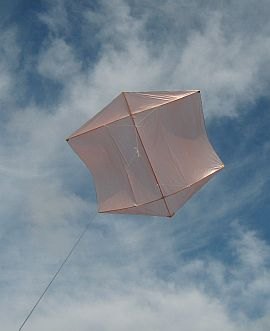 MBK Dowel Rokkaku
Anything you don't have is easily bought. If it's not exactly what I used, then at least something pretty similar!
The MBK Dowel Rokkaku is a fairly large tailless design based on the traditional Japanese kite.
However, this rok will still fit into nearly all road vehicles, ready to fly—either just in front of the rear seat or flat in the trunk (boot).
Like the other Japanese design in this series, the sode, this kite is a light-to-moderate-wind flier.
Setting up on the flying field is just a matter of attaching the bow-line toggles to put some curvature into both the horizontal spars. Then the flying line is attached to the bridle.
At this point you are ready to launch! The method of attachment is illustrated further down this page.
I have chosen to make "One Dowel Length" equal to 120 cm for every kite in the Dowel Series. If you are in North America, 48 in. of 3/16 in. dowel is close enough to 120 cm of 5 mm dowel. This will result in a kite with similar flying characteristics to my original. Make sure to find a hardwood type for your dowel.

On this site, there's more kite-making info than you can poke a stick at. :-)
Want to know the most convenient way of using it all?
The Big MBK E-book Bundle is a collection of downloads—printable PDF files which provide step-by-step instructions for many kites large and small.
That's every kite in every MBK series.
How to Make a Rokkaku Kite
Cutting the Sail
Now's the time to read up on the kite-making tools and materials required for making a Dowel Rokkaku, if you haven't already. For this kite, you will also need some cheap thin shoelaces.
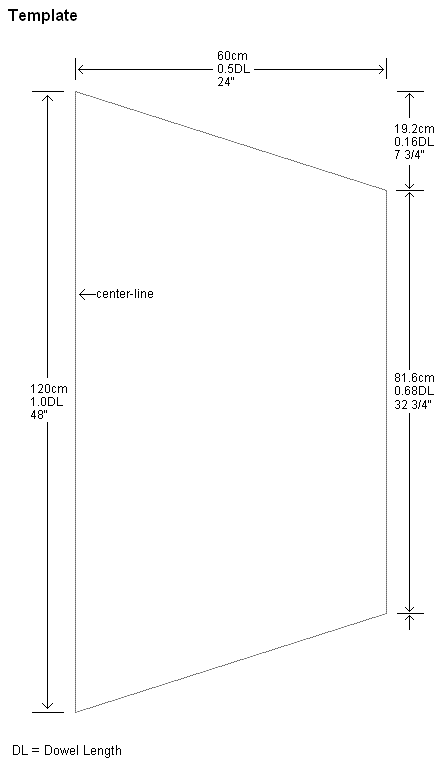
The template shown above represents one side of the kite sail. You will now transfer these measurements to the sail plastic.
Like to see a video clip? Just scroll down to near the end of this page.
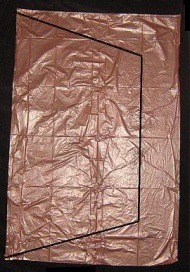
Note: In order to fit the length of an 80-liter garden bag, I made this design shorter than a traditional 4:5:6 rok of the same wingspan. You see, I'm trying to standardize on a 1.2 meter wingspan for all the Dowel Series kites!
- First, take a large bag that you want to use for the sail, and lay it flat on the floor.
- Mark dots on the plastic that correspond to the corners of the template. There is no need to use a T-square or an extra-long ruler, since any small errors in position will be duplicated on the other side of the sail.
- Using the marking pen, rule lines between the dots as in the photo. For lines longer than the ruler, just add a few extra dots using one of the dowel spars as a ruler! Then it's easy to connect the dots with a ruler. It's probably best not to rule the whole line with the dowel, since it bends easily.
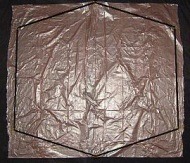
- Flip the plastic bag over, and trace over all the black lines using your marker pen and ruler.
- Cut out a rectangular section of the bag containing the kite sail, open it out and lay it flat on the floor; you can now see the complete sail outline as in the photo.
When doing the following, most of the width of the tape should be inside
the kite's outline. Use a single length of tape for each line. Hold it
out straight; touch it down to the plastic at one end then at the other
end; dab it down in the middle then press down all along its length.
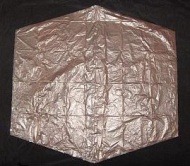
- Lay clear sticking tape along all the lines, letting it overlap at the corners.
- With scissors, cut along all the black lines. This will leave most of the width of the sticking tape inside the sail outline. See the photo.
As mentioned earlier, there's more kite making on this site than you can poke a stick at. :-)
Want to know the most convenient way of using it all?
The Big MBK E-book Bundle is a collection of downloads—printable PDF files which provide step-by-step instructions for many kites large and small.
That's every kite in every MBK series.
