- Home Page
- For Small Kids
- ... Child Fliers
Kite Making for Child Fliers
Tips for the Classic Diamond
Are you a parent or teacher interested in kite making for child fliers? Seeing a kite flying draws kids like a moth to a flame, if you hadn't noticed already!
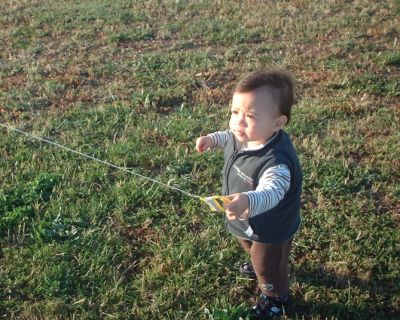 Start 'em young, very young—we did!
What I've done here is to give general tips for quickly whipping together working diamond kites for kids—cheap and simple.
Why a diamond kite in particular? Because it's
- simple—just two sticks, some clear adhesive tape, and some thin plastic
- tolerant—even a roughly made diamond will fly
- recognizable—instant excitement for the kid, since they've seen it on TV so many times
On this site, there's more kite-making info than you can poke a stick at. :-)
Want to know the most convenient way of using it all?
The Big MBK E-book Bundle is a collection of downloads—printable PDF files which provide step-by-step instructions for many kites large and small.
That's every kite in every MBK series.
Kite Making for Child Fliers
Considerations
Making a small kite is very appropriate for kids, particularly the smallest children. This makes it easy for them to hang on to the flying line. Bigger kites can pull quite strongly. Besides the light pulling force, a small kite is more easily carried around and stored—even under the pram in the case of a very small kid like our Aren was once! Aren features from time to time in the Flight Reports section of this website.
Whatever materials you end up using when kite making for child kiters, remember that the lighter the better. Light kites don't waste so much of their lifting force on lifting their own weight in addition to the weight of the flying line. Lighter kites fly higher, all other things being equal. Also, heavy kites won't fly in very light breezes.
Regarding the color of the plastic, the brighter the better. A kid's kite is less interesting if he or she has trouble spotting it when 50 meters (150 feet) up!
Kite Making for Child Fliers
Materials
OK, it's time for the nitty-gritty! First, here are some ideas for materials:
For the two sticks, or to use the correct term, kite spars, there are a few options. I've listed them in order of preference:
- bamboo BBQ skewers—light and strong
- plastic or paper drinking straws—strong enough if not crushed
- wooden or plastic rods—OK if thin enough to be reasonably light
Having both sticks exactly the same length will work fine.
For the sail and tail, any lightweight plastic sheet will do; for example, use freezer bags or shopping bags. The lighter and thinner the better. Clear plastic will be difficult to see except near sunset. Then it can put on quite a show, surprisingly!
You will want some adhesive tape. For a small kite about as tall as an adult forearm, almost any sort of clear office-use tape will do. It should be roughly the width of your finger. Forget masking tape and other heavier types. In the pictures below I've used bits of cut-up packing tape. This was just to make them easier to see. You'll probably be using the clear stuff.
For making the bridle and binding the two sticks together, you need some polyester sewing thread. The lightest grades are suitable for a 30 centimeter (12 inch) span kite like the one described below.
For larger kites, use heavier grades of thread. However, for kites over 100 centimeters (36 inches) in span, switch to Dacron or nylon line from a kite shop. As a last resort, string or wool could be used; just don't expect the kite to soar high on the slightest whiffs of breeze!
Kite Making for Child Fliers
A Simple Method
Here is my simplified procedure for making a rough-and-ready little diamond kite, regardless of what exact materials you have chosen. It's very imprecise, but it's almost certain to produce a flyable kite—in record time too!

Step 1. Form the classic diamond shape by crossing one stick over the other. Bind the sticks together with cotton line or anything else that doesn't seem too thick or heavy.
The exact shape of the diamond doesn't matter. Try to make it reasonably symmetrical though. Check by eye to see that both sides, left and right, seem the same size.
Another trick is to suspend the vertical spar on two fingers, and then push the cross spar through the binding until it balances better.

Step 2. Lay down a sheet of your chosen sail plastic flat on a tabletop or the floor.
Now lay the two-stick cross on top of the plastic. There should be plenty of room for your sticks on the plastic.
Use tape to stick down the spars to the plastic. Don't overdo it; four strips on each stick is enough as in the photo.

Step 3. With a ruler or even by hand, use a marking pen to draw a diamond outline around the sticks. Four straight lines should connect all four stick-ends in a diamond shape.
Now take out a pair of sharp scissors, and cut around the diamond. See the photo.
Hey, this is starting to look like a kite already!

Step 4. Carefully put an adhesive tape cap on all four spar ends. For each spar end:
- pull off a length of tape about as long as an adult's finger
- lay the tape along the spar, letting half the tape hang off past the spar's tip
- fold the hanging tape around to the other side, and stick down to the sail plastic
Each corner of the kite should now be neatly covered in tape with the sail plastic held firmly to each corner of the kite. The photo shows the right hand tip before the tape is folded under and stuck to the other side.

Step 5. Now for the bridle, which connects the flying line to the kite. Cut a small hole in the plastic sail near each end of the vertical spar. Take a length of cotton line, or whatever you have decided to use for the bridle, about three times the length of a kite spar. Feed each end through the holes in the plastic, and loop it around the spar a few times. Then feed the line back through the hole, and tie it off firmly. If you're worried about whether the knots might slip, use a drop of fast-drying glue to fix each knot to the spar.
Now tie a loop into the bridle. Where? The loop should be either directly over where the sticks cross, or a little further toward the nose or top of the kite. With the bridle laid over to the side, it should look something like in the photo. Although a bit hard to see, there's the bridle off to the left, with the loop in the end.

Step 6. Cut a tail out of a plastic bag, cutting it round and round like peeling an apple. Keep going until you have a length that is at least six times as long as the kite itself. Use another bag and stick the two ribbons together, if one bag is not long enough. The width of the tail should be around an eighth to a quarter of the width of the kite itself. This tail doesn't have to be accurately done at all! Just get the width and length roughly right.
When you have a nice long tail, simply stick one end onto the bottom of the kite. You can use a bit more tape here, since you don't want the tail to fall off on the first flight! I've used clear tape in the photo so you can see how I fitted the tail around the lower bridle attachment point. I also used a bit of tape on the other side of the kite for extra strength.
That's it about kite making for child fliers or anyone else who wants to make a working kite—cheaply and really quickly!

Flying the kite! Attach a polyester sewing thread line to the bridle loop, and you're ready to fly.
A convenient way to do this is to tie the flying line to one end of a small paper clip. Then just slip on the bridle loop so it's looped around the other end of the paper clip. The photos make it pretty clear, although I've attached a thicker cotton flying line to make it easier to see.
See how the paper clip has been bent too, in the bottom closeup photo.
This way, you can easily swap your flying line from kite to kite if you make more than one.
Kite Making for Child Fliers
The Child
It's for you to judge just how much your child can do in constructing the kite.
At one end of the scale, if the child is very young or of low ability for some reason, they could simply paste a few decorative bits onto the sail of the completed kite and perhaps stick the tail to the kite with tape.
However, older kids should be able to do it all with some supervision. I've kept things ultra-simple for this reason. However, I read somewhere that many kids have trouble with knots, so be ready to help in this area.
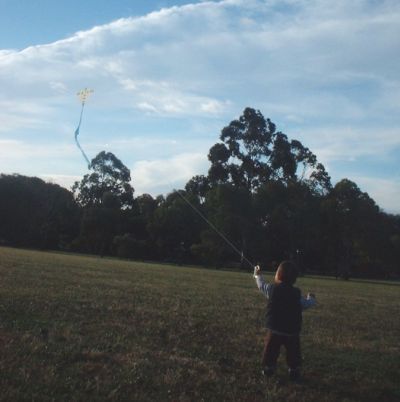 Toddler kite pilot
Have fun kite making for child kite-fliers and fanciers! Just be careful with two-year-old kite wreckers. Our first MBK 1-Skewer Diamond kite still bears the scars of our marauding toddler, Aren ;-) That's him in the photo.
As mentioned earlier, there's more kite making on this site than you can poke a stick at. :-)
Want to know the most convenient way of using it all?
The Big MBK E-book Bundle is a collection of downloads—printable PDF files which provide step-by-step instructions for many kites large and small.
That's every kite in every MBK series.
