- Home Page
- Better Kites
- ... Sode Kite
How to Make a Sode Kite
Step-by-Step—Page 1 of 3
The MBK 1-Skewer Sode
This set of instructions on how to make a sode kite assumes you know absolutely nothing about kite making.
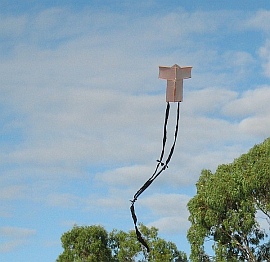 MBK 1-Skewer Sode
You might already have some of the simple tools and materials required. Anything you don't have is easily bought. If not exactly what I used, then at least something pretty similar!
These instructions on how to make a sode kite might look a bit long, but each step is quite simple to do. Just steadily work your way through from top to bottom, skimming over any detail that you don't need.
At 29 cm (11 1/2 in.) across, the MBK 1-Skewer Sode kite is rather small.
This sode has dihedral on the horizontal spars, a simple two-leg bridle and a looped tail. In anything more than moderate winds, you might need more tail than is described here.
Note the extra length of tail added to the bottom of the loop, in the photo!

On this site, there's more kite-making info than you can poke a stick at. :-)
Want to know the most convenient way of using it all?
The Big MBK E-book Bundle is a collection of downloads—printable PDF files which provide step-by-step instructions for many kites large and small.
That's every kite in every MBK series.
How to Make a Sode Kite
Sail
Now's the time to read up on the tools and materials required for making a skewer kite, if you haven't already.
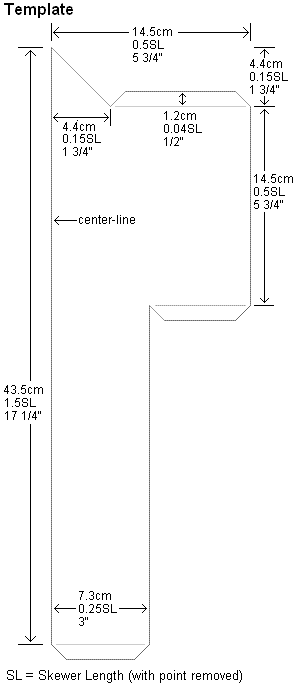
The template shown above represents one side of the kite sail. You will now transfer these measurements to the sail plastic.
Like to see a video clip? Just scroll down to near the end of this page.
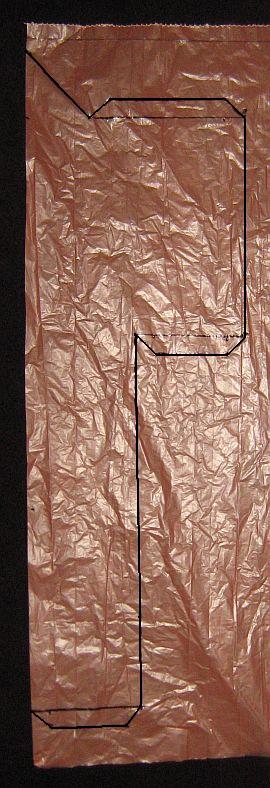
- First, take a light plastic bag that will fit the entire template shape within one side, and lay it flat on the floor.
- Mark dots on the plastic, corresponding to the corners of the template. There is no need to use a T-square, since any small error will be duplicated on the other side of the sail.
- Using the marking
pen, rule lines between the dots as in the photo. Note that the camera has
distorted the image slightly, making some of the straight lines curve a
little.
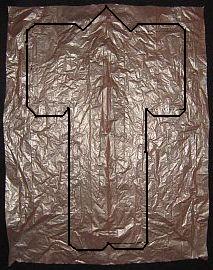
- Flip the plastic bag over, and trace over all the black lines using your marker pen and ruler.
- Cut out a rectangular section of the bag containing the kite sail; open it out, and lay it flat on the floor; you can now see the complete sail outline as in the photo.
- Cut along the black lines with scissors to create the sail.
How to Make a Sode Kite
Vertical Spar
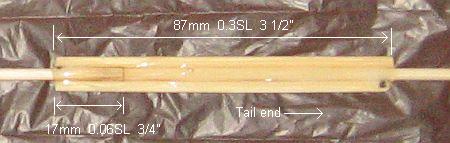
The vertical spar is 1.5 SL (43.5 cm, 17 1/4 in.) long, so two 30 cm (12 in.) bamboo BBQ skewers need to be glued together:
- Snip the point off one skewer.
- Lay down another skewer, butting together two flat skewer-ends.
- From yet another skewer, cut off two lengths of 0.3 SL (8.7 cm, 3 1/2 in.) each. Place these beside the join as in the photo.
- Lay down a line of wood glue on each side, and leave to dry. The joint also serves to bring the balance point back toward the tail for more stability.
- Get down low, and look along the skewers to ensure they make a straight line before the glue sets! The photo shows the join after the glue has set.
The video below shows that longer tail in action! The breeze was quite fresh way up there. Just look at that cloud cover moving past:
As mentioned earlier, there's more kite making on this site than you can poke a stick at. :-)
Want to know the most convenient way of using it all?
The Big MBK E-book Bundle is a collection of downloads—printable PDF files which provide step-by-step instructions for many kites large and small.
That's every kite in every MBK series.
