Home
what's new?
kite flying blog
newsletter
how to make...
kite plans
kids' kites
paper kites
power kites
chinese kites
box kites
stunt kites
aerial photography
kite festivals
Adelaide events
mbk kite club
our kite reviews
earliest kite flying
kites under $20!
kite books
about the webmaster
 

How To Make A Roller Kite

Complete Instructions For The MBK Skewer Roller Kite

About the only tool required by these instructions on how to make a Roller kite is a pair of sharp scissors. Any other materials you don't have are easily bought from local shops. If not exactly what I used, then at least something pretty similar!

These instructions on how to build a Roller kite are fairly detailed, since this is more involved than making a diamond, for example! However, the reward is a nice little moderate wind flier. Just quickly work your way through from top to bottom, skimming over any detail that you don't need.

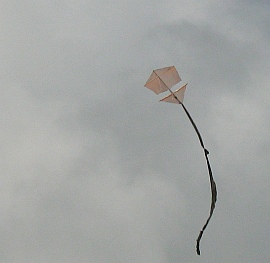
The MBK Skewer Roller Kite is quite small at 29 x 29 cm square. Due to its small scale, this one is designed with a somewhat bigger gap between the upper and lower sails, to aid stability. Even so, it flies best with a short tail.

Could you do me a small favor at this point? Just take a few seconds to complete a very short survey. Thanks!


Subscribe to the MBK Flying Skewers And Plastic newsletter for fresh instructions each month for a new type of skewer kite to make. Have fun making this kite with your kids, or just for your own enjoyment!


How To Make A Roller Kite - Materials

How to make a kite - materials


Lightweight sticky tape. Scotch tape, Sello-tape, sticking tape, whatever you like to call it. Just make sure it is about the width of your finger. The tape I use is 12mm (1/2 inch) in width.

Lightweight plastic bags. Here in Australia, the large sized freezer bags are perfect for small kites. These measure 30 x 45 cm (12 x 18 inches) I'm sure there are similar products in other parts of the world. For a kite this small, the lighter the plastic, the better. My originals are in clear freezer bag plastic, but you might prefer to use a colored plastic shopping bag in order to see the kite better! However, these instructions assume that you can see black marker pen marks through the plastic when it's lying on a table.

Bamboo BBQ skewers. The ones pictured are 30 cm (12 inches) in length, just a few dollars for a packet of 100. If yours are a different length, don't worry. These instructions don't rely on absolute measurements for the spars or sail material. You will still end up with a flyable kite.

3 kg (8 pound) or more flying line, for the bridle lines and tail attachment loops. These days I'm using 20 pound Dacron for flying line and bridling. You might use Nylon, Polyester or good old cotton.

Wood glue, such as Aquadhere. Good for tacking bits of bamboo together. 100 ml will last a long time when just used for making MBK kites. Don't ask me how much 100 ml is in quarts or US gallons... ;-) Ok, it's a small container that nearly disappears in an average-sized man's fist! If you prefer, and don't mind paying more, there are various quick-drying wood or general-purpose glues on the market that can also be used.

Now for a few extras you need to help with making a Roller kite...

A felt-tipped black marking pen. Most of these should work on plastic. This is for marking corner points and cutting lines on the sail plastic.

A ruler. Any length or type will do, to make measurements and sometimes to rule lines. All MBK kites use straight lines to make things easier.

A pair of scissors. These are mainly for cutting around the outline of the sail. They are also handy for snipping bamboo skewers to length.

A calculator. Yes, a calculator of some sort, like on your mobile phone or the Windows one or whatever. But there's no heavy calculating to be done, it's just handy for getting some alignment marks in exactly the right spot, on the bamboo spars. In fact, right now, snip off the point from one of your skewers and measure the skewer. This is 'one skewer length'. Write this measurement down somewhere.

A smooth flat space to work on. If you are cutting the sail with a knife rather than scissors, you will need a smooth flat surface that can be sliced into without upsetting anyone else! So forget the 2-ton 17th Century polished oak table at your rich uncle's house...

A little tip regarding making marks on the bamboo spars - twirl the bamboo around in your fingers while making the mark, so the mark goes all the way around. This way, it doesn't matter how the spar sits, you can always see that mark!

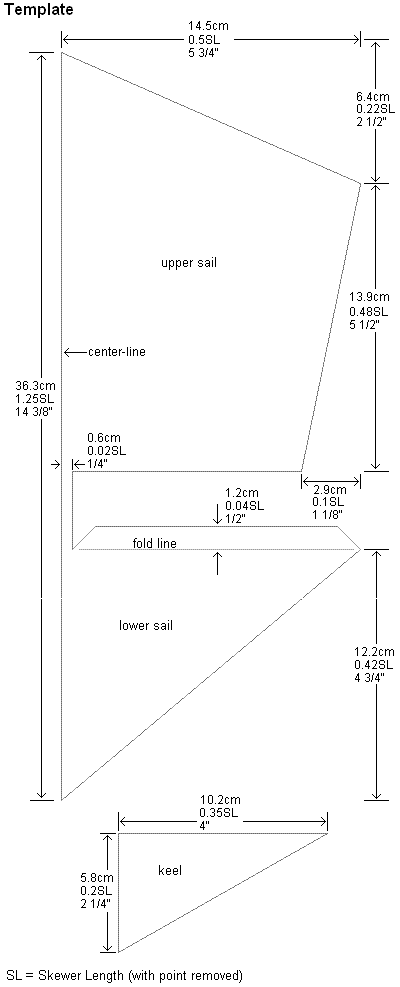
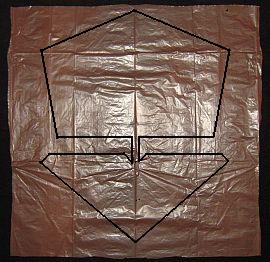
How to make a Roller kite - plan


How To Make A Roller Kite - The Sails

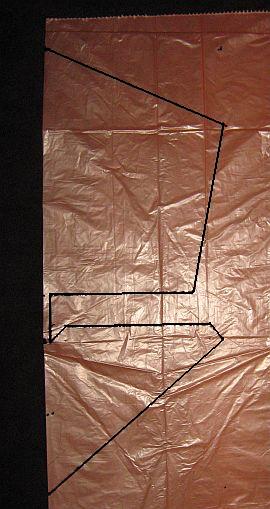
How to make a Roller kite - mark outline


  1. lay a large freezer bag flat on the table
  2. with the felt pen, make 2 marks near one edge of the bag, exactly one skewer length apart - not the sealed end or the open end, one of the 2 side edges of the bag
  3. referring to the plan, mark all the corners with dots, for one side of the kite on one side of the plastic
  4. make another 2 marks near the side edge, corresponding to where the sails will cross the vertical spar - see all the marks in the photo
  5. using the ruler and felt pen, draw straight lines between all the dots, as per the photo

Tip 1: Just use your eye to keep everything square - any small inaccuracies will be exactly the same on both sides, so it doesn't matter!

Tip 2: For neatness and accuracy you might like to make your dots much smaller than those in the photo - I just did it that way so they were easily visible!

How to make a Roller kite - tape and cut sails


  1. flip the bag over, and draw over the top of all the lines you can see through the plastic
  2. with scissors, cut off the edges of the bag so you can open it out and lay it flat, with all the lines on top - DON'T cut along the lines yet!
  3. lay down sticky tape along all the lines, with the each line right in the middle of the tape as in the photo - use plenty of tape, don't worry about overlaps
  4. with the scissors, carefully cut along all the black lines until you are left with 2 sails - just like on the plan

Each of the Roller sails now has a neat rim of tape, reinforcing the edge. The tape's a bit hard to see in the photos, I know.


How To Make A Roller Kite - Adding The Frame

How to make a Roller kite - tape sails to frame


  1. snip the point off a skewer to make the vertical spar
  2. lay down the 2 sails as per the plan and then lay down the vertical spar, taping where indicated in red - to leave room to attach the tail, use just a little tape on the lower end, as indicated in the photo
  3. now cut the points off 2 more skewers, to your exact '1 skewer length' - these are your horizontal spars
  4. lay down the 2 horizontal spars as per the plan, and tape where indicated on the photo

How to make a Roller kite - glue frame


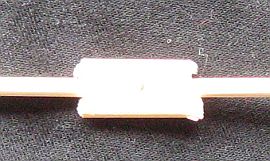
  1. take a deep breath, put your thumb on the center of the upper spar and bend one end away from the table until it starts to make breaking noises - but don't snap it in half!
  2. if necessary, repeat this with the other end as well, until the spar finally sits by itself at approximately the angle shown in the plan Front view
  3. judging by eye, prop up the ends of the spar to about 15 or 20 degrees off the table
  4. cut a length of bamboo 0.1 of a skewer length long, and lay it beside the bend in the spar - see the plan
  5. drip glue where the 3 spars cross each other, and also lay a line of glue all along the bend
  6. if necessary, weigh down the center of the bent spar with something, as in the photo - the piece of white paper is just to keep the glue off the table

Hint: use plenty of glue on that center joint with the bend, it can be under a lot of stress when flying in strong wind...

Hey, it's starting to look like a Roller kite! While this is drying, you can get on with the rear keel.


How To Make A Roller Kite Keel

How to make a Roller kite - cutting the keel


  1. take a rectangle of some different colored plastic - I used a yellow shopping bag - with enough area to mark out a keel as per the dimensions on the plan
  2. using the ruler and pen, mark out the keel triangle
  3. cut along the lines, which leaves you with the keel

Now take this plastic triangle and...

How to make a Roller kite - taping the keel


Again, in this photo, pieces of tape are indicated by red rectangles.

  1. snip off 4 pieces of flying line, each about 2/3 of a skewer length long - this gives plenty of length for putting all the knots in
  2. lay down 2 lengths of flying line onto one side, like the keel in the plan
  3. tape down the lines, flip the keel over and tape down another 2 lengths of flying line, directly over the first 2
  4. reinforce the keel on both sides by sticking down and wrapping more tape where indicated in red, in the photo
  5. where the 4 pieces of line come together, tie a knot close to the plastic, then tie another one further out, as in the photo
  6. where 2 pieces of line come together, tie a knot as close as you can to the plastic, as in the photo


How To Make A Roller Kite - Sail Tethering

How to make a Roller kite - upper sail tethering


At this point you need to make sure the glue is dry on the frame. If it is...

  1. lay down the kite with the bamboo on top, and cut 2 short lengths of flying line - about half a skewer length each
  2. first, tape the lines to the lower sail near the tips - over the bamboo, around the sail edge and then back towards the bamboo - as in the photo
  3. lay the lines across the upper sail and tape them down, leaving not quite as much slack as in the photo!

tip: Tape down the line at the corners of the upper sail with small square bits of tape first. Then pull both lines through the tape until the right amount of slack is present. Then use longer pieces of tape on the upper sail to make sure the lines don't slip any more! You will, however, still be able to pull the line through a little if needed, in case the kite doesn't fly straight.


How To Make A Roller Kite Bridle

How to make a Roller kite - the bridle


Firstly, attach the keel...

  1. poke 2 holes in the lower sail, near the lower horizontal spar, where indicated on the plan - actually right next to the tape is best, but don't attempt to go through the tape
  2. take the keel, poke the upper 2 lines through the holes near the horizontal spar, pull tight against the knot, then tie them off around the bamboo
  3. now poke the bottom 2 holes in the plastic, using the keel to find the exact spots for the holes
  4. thread the lines, pull tight against the knots, and tie them off tightly around the bamboo

How to make a Roller kite - the bridle line


Next, attach the bridle...

  1. lay the kite down with the keel on top, then cut a length of flying line, about 3 skewers long
  2. tie a double knot into one end, and a simple overhand loop into the other
  3. poke 2 holes in the upper sail where indicated on the plan
  4. attach the double-knotted end to the vertical spar through the 2 holes in the upper sail - use a simple hitch and pull tight against the knot
  5. attach the looped end to the keel using a Larks Head, and pull tight against the keel's big knot

The photo shows the Larks Head attached but not tightened.

prussik knot

Finally, take a length of flying line about half a skewer long, and tie one end to the bridle line with a Prussik knot. Tie a small simple overhand loop into the other end, just to get a nice big knot.


How To Make A Roller Kite Tail

Making a tail for a simple kite is very easy. However, if you would like to copy my MBK Roller kite design exactly, try the following. It works well and is just a little more interesting to make than long straight ribbons.

How to make a Roller kite - bag rings

This tail is made from just one large freezer bag cut into rings about 3 cm (1 inch) wide. A tip... No need for perfectly straight lines here, just cut the plastic by eye with scissors. Start at the open end of the bag and cut it all into rings, throwing away the last bit.


How to make a Roller kite - 3 bag rings looped together

The photo shows 3 rings looped together, with one knot pulled tight and the other one left loose to show you how it's done.

Loop rings together until you have a tail at least 5 times as long as the kite itself.

How to make a Roller kite - tail


To attach the tail to the kite, just push one end between the vertical spar and the sail, at the lower end of the kite. Loop the other end of the tail through the loop that was pushed under the bamboo. Pull the tail all the way through, but leave it a bit loose in case you want to change the tail later. There's the completed kite in the photo.

At this point, you've pretty much finished learning how to make a Roller kite!

How to make a Roller kite - line, bridle close-up


Finally, make up a flying line. I keep things extremely basic with a simple winder made from a small rectangular piece of wood. A rounded file with fairly coarse grade will quickly create a curved cut-away on the top and bottom of the winder. About 50 meters (150 feet) of line is enough to give a new kite a good test fly.

Put a simple overhand loop into the end of the flying line, then attach it to the kite's bridle using a Lark's Head knot. Very simple, I've tried to make it clear in the photo. Doing it this way makes it easy to remove the line later.

How to make a Roller kite - launching


Here's a picture of my wife May flying our original MBK Skewer Roller kite, in the dunes at Semaphore beach, Adelaide.


How To Make A Roller Kite - Flying Tips

Before flying, just check the kite's balance, indoors. Take the flying line off the bridle first...

Hold the kite under its nose and tail, and suddenly take both hands away. Does the kite nose down and fly forward? If so, keep adding tape across the trailing edge of the sail. The kite should either float straight down to the floor or show only a very slight tendency to dive forwards or backwards.

Assuming there is some breeze outside, just dangle the kite at arm's length until the wind catches it. As long as you feel the kite pulling, let out line slowly by letting it slip through your fingers.

Another approach is to get a helper to hold the kite up and let it go, with maybe 10 or 20 meters of line let out. This way, the kite soon gets high enough to make it easy to let more line out.

Have fun flying, and I hope you've enjoyed learning how to make a Roller kite!


Last updated: 27 Mar 2008


Return to How To Make A Kite from How To Make A Roller Kite

All the way back to Home Page

footer for how to make a roller kite page