How To Make A Diamond Kite

Step-by-Step - The MBK 1-Skewer Diamond

This set of instructions on how to make a Diamond kite assumes you know absolutely nothing about kite making. You might already have some of the simple tools and materials required.
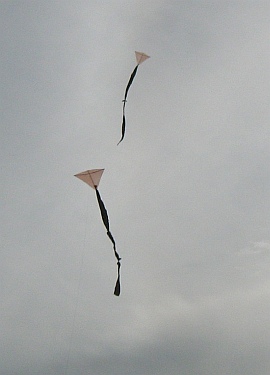
How to make a Diamond kite like these.

Anything you don't have is easily bought. If not exactly what I used, then at least something pretty similar!

These instructions on how to make a Diamond kite might look a bit long, but each step is quite simple to do. Just steadily work your way through from top to bottom, skimming over any detail that you don't need.

At 29cm (11 1/2") tall, the MBK 1-Skewer Diamond Kite is a rather small Diamond, with dihedral and simple 1-leg bridle. With a long enough tail, it is equally at home in light or moderate strength winds.

As a bonus, these instructions also show you how to string several of these kites together in a kite train!

There's a 2-kite train over there on the left.  This design is so cheap and easy, why not try an even longer train. Imagine 10 or more, all flying on the one line!

1-Skewer kites are fun, but somewhat toy-like :-)  due to their rather small size. Fancy something much bigger to fly, suitable for teenagers and adults?

Have a look at the e-book up there on the right. So you can work from nicely-formatted printouts or direct from the screen on your laptop or other device while offline.

1-Skewer kites are fun, but somewhat toy-like :-)  due to their rather small size. Fancy something much bigger to fly, suitable for teenagers and adults?

This e-book of step-by-step instructions will help you make a much larger version, in wooden dowels and plastic.


How To Make A Diamond Kite - Sail

Now's the time to read up on the 'tools' and materials required for making a Skewer kite, if you haven't already.

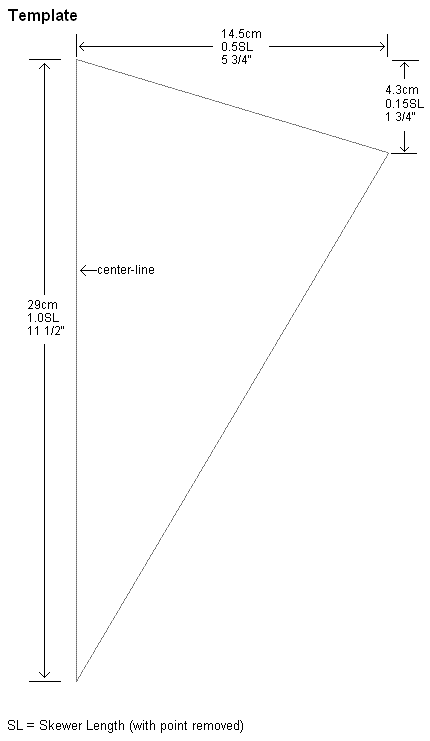
Sail template for the 1-Skewer Diamond kite.

The template shown above represents one side of the kite sail. You will now transfer these measurements to the sail plastic as follows...

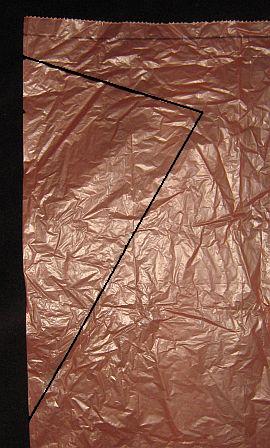
The 1-Skewer Diamond - template drawn onto bag.


  • Firstly, take a light plastic bag that will fit the entire Template shape within one side, and lay it flat on the floor.
  • Mark dots on the plastic, corresponding to the corners of the Template. There is no need to use a T-square, since any small error will be duplicated on the other side of the sail.
  • Using the marking pen, rule lines between the dots, as in the photo.


The 1-Skewer Diamond - template shape traced and bag opened out.
  • Flip the plastic bag over, and trace over all the black lines using your marker pen and ruler.
  • Cut out a rectangular section of the bag containing the kite sail, open it out and lay it flat on the floor - you can now see the complete sail outline, as in the photo.
  • Cut along the black lines with scissors, to create the sail.


How To Make A Diamond Kite - Spars

For this Diamond, you need two 30cm (12") bamboo BBQ skewers. The photo shows them laid over the sail, before being snipped to length with scissors.

The 1-Skewer Diamond - skewers over sail
  • Lay down a skewer over the center crease of the plastic, lining up the non-pointy end with the top corner of the plastic. Snip off the pointed end so the skewer lines up with the bottom corner of the plastic as well. This is the vertical spar.
  • Lay down another skewer across the left and right corners of the sail, and again snip to length, removing the point. Also make an easily-seen mark on the skewer at the exact center-point. This is the horizontal spar.
  • Using a sharp corner, perhaps a blade of the scissors, make an indent in the bamboo, at the center-point you marked.


How To Make A Diamond Kite - Attaching Sail

The 1-Skewer Diamond - tip and crossing-point detail
  • Lay down the vertical spar skewer over the sail, and wrap a short length of clear sticky tape around each tip, securing them to the top and bottom corners of the sail. The top photo shows the top tip in close-up.
  • Lay down the horizontal spar skewer and attach its tips to the left and right corners of the sail, in the same way.
  • Bend the horizontal spar in the middle, until it starts to crack at the indent! Carefully increase the bend until you can get the kite looking like the one in the middle photo. If you want to be precise, each wing-tip is 0.13SL (3.7cm, 1 1/2") off the table top.
  • Dribble some wood glue all around where the skewers cross each other. See the bottom photo over there.

Wait for the glue to dry. Maybe start another one of these kites, so you can fly them together in a train later on!


How To Make A Diamond Kite - Bridle

The 1-Skewer Diamond - bridle and rearn attachment.
  • Cut off some 20 pound bridle line to a length of 1.0SL (29cm, 11 1/2"), and tie a very small Loop Knot into each end. See the top photo.
  • Poke a hole in the plastic sail, 0.22SL (6.4cm, 2 1/2") from the top tip of the vertical spar.
  • Tie the middle of the line to the vertical spar with a simple Granny Knot. Poke one end through the hole in the sail, and leave the other end hanging. See the bottom photo.
  • Secure the knot onto the bamboo of the vertical spar with a tiny blob of wood glue, so it can't shift up or down the spar.


How To Make A Diamond Kite - Tail

The 1-Skewer Diamond - tail attachment
  • Cut out a long thin rectangle of colored plastic for the tail. Mine is black, to contrast with the orange sail. Make it 8.0SL (230cm, 90") long and 0.2SL (5.8cm, 2 1/4") wide. Knot pieces together if necessary, to get the full length. Avoid taping, because it adds weight!
  • Tie one end around the vertical spar, as close as possible to the bottom tip. See the photo. A single Half Hitch will do, since there are very low forces on the tail in flight.


The 1-Skewer Diamond - attaching the flying line

At this point, you've finished making the 1-Skewer Diamond!

To attach the flying line, just Lark's Head the flying line to the short kite line as in the photo.

Now for the cool bit... If you have made 2 or more kites, each attached to their own flying line, you can hitch them together in a train. Just put a fair-sized Loop Knot into both ends of each flying line, and then it's easy to attach and un-attach the kites. My first 2 Diamonds flew great with a 10 meter (35 feet) line between them.


How To Make A Diamond Kite - Flying!

The MBK 1-Skewer Diamond kite in flight.

Firstly, if it's very windy outside, stay home! This is a light-to-moderate wind kite and won't like being launched in a gale.

Assuming there is some breeze outside, just dangle the kite at arm's length until the wind catches it. As long as you feel the kite pulling, let out line slowly by taking loop after loop off the winder.

Another approach is to get a helper to hold the kite up and let it go, on the end of maybe 10 or 20 meters (around 50 feet) of line. This way, the kite soon gets high enough to make it easy to let more line out.

The picture shows this latest version of the 1-Skewer Diamond on its second outing. Coping well in a very gusty moderate breeze.

Have fun flying, and I hope you've enjoyed learning how to make a Diamond kite!


The "Making Skewer Kites" e-book has this design and many others in bamboo skewers and plastic. A handy approach is to just print out the pages for the kite you want to make next. The e-book is also handy for working off-line on a laptop or other device.

That's great value already, but "The Big MBK Book Bundle" is even better! This includes the "Making Dowel Kites" compilation e-book, plus several other handy kiting e-books.


Now, just in case you have actually made and flown this kite at least once already...


Ever Made This Kite?

You've probably read a kite-flying story or 2 of mine, after they appear under the "what's new?" link on this site. I sometimes wonder if anyone else has made and flown this particular design...

If you feel your efforts really paid off when the the kite finally got airborne - please type a few paragraphs in here telling us all about it!

P.S. I can only accept stories of at least 300 words. Just mention a few details like the weather, onlookers, the kite's behavior and so on - 300 words is easy!

Please Enter A Title

Flight Reports From Other Visitors

Click below to read about various kite-flying adventures, contributed by other visitors to this page...

The Idiot Proof Kite 
This kite flew quite well. As you can gather from the name, it was easy to make. I would recommend the 1-Skewer Diamond to any person who doesn't have …

Click here to write your own.


New! Comments

Plenty of fun kite info, photos and videos - there's definitely too much here for only one visit! Feel free to leave your impressions of this site or just this page, below...


Return to How To Make A Kite from How To Make A Diamond Kite

All the way back to Home Page


[?]Subscribe To This Site
  • XML RSS
  • Add to Google
  • Add to My Yahoo!
  • Add to My MSN

Never made a kite?
Kite unsuccessful?
Child wants one?
Check out the...
MBK Beginner E-course


E-books

Kite Book - Making The MBK Dowel Diamond Kite.

Download
"Making The
MBK Dowel Diamond Kite"


Watch it fly!

Kite Book - Making The MBK Dowel Diamond Kite.

A closer view

Download
printable e-book


Make
all the Dowel kites, including the one above...

Kite Book - Making Dowel Kites

Download
"Making Dowel Kites
"


The ultimate kite-making resource, and naturally
much better value...

Kite Book - The Big MBK Book Bundle

Download the
"MBK Book Bundle"


Free Stuff

Are the e-books good?
Find out by trying...
'Simplest Dowel Kites'
(wait for cover page to appear)

Check out..