How To Make A Delta Kite
Complete Instructions For The MBK Skewer Delta Kite
About the only tool required by these instructions on how to make a Delta kite is a pair of sharp scissors. Any other materials you don't have are easily bought from local shops. If not exactly what I used, then at least something pretty similar! These instructions for making a Delta kite are fairly detailed, since getting a small home-made delta kite to fly well takes some doing! However, the reward is a really excellent light wind flier! The pictures should make things pretty clear. Just quickly work your way through from top to bottom, skimming over any detail that you don't need. The MBK Skewer Delta Kite is quite small at 29 cm tall, and flies best with a short tail. Could you do me a small favor at this point? Just take a few seconds to complete a very short survey. Thanks!
Subscribe to the MBK Flying Skewers And Plastic newsletter for fresh instructions each month for a new type of simple kite to make. Have fun kite making with your kids, or just for your own enjoyment!
How To Make A Delta Kite - Materials
Lightweight sticky tape. Scotch tape, Sello-tape, sticking tape, whatever you like to call it. Just make sure it is about the width of your finger. The tape I use is 12mm (1/2 inch) in width. Lightweight plastic bags. Here in Australia, the large sized freezer bags are perfect for small kites, although plastic shopping bags can also be used. I'm sure there are similar products in other parts of the world. For a kite this small, the lighter the plastic, the better. My originals are in clear freezer bag plastic, but you might prefer to use a colored plastic shopping bag in order to see the kite better! Bamboo BBQ skewers. The ones pictured are 30 cm (12 inches) in length, just a few dollars for a whole packet. If yours are a different length, don't worry. These instructions don't rely on absolute measurements for the spars or sail material. You will still end up with a flyable kite. 3 kg (8 pound) or more flying line, for the bridle lines and tail attachment loops. These days I'm using braided Dacron for flying and bridling. You might use Nylon, Polyester or good old cotton. Wood glue, such as Aquadhere. Good for tacking bits of bamboo together. 100 ml will last a long time when just used for making MBK kites. Don't ask me how much 100 ml is in quarts or US gallons... ;-) Ok, it's a small container that nearly disappears in an average-sized man's fist! If you prefer, and don't mind paying more, there are various quick-drying wood or general-purpose glues on the market that can also be used. Now for a few extras you need to help with making a Delta kite... A felt-tipped marking pen. Most of these should work on plastic. This is for marking lines on the freezer bag plastic so you can later cut out the kite sail from it. A ruler. Any length or type will do. All MBK kites use straight lines to make things easier. A pair of scissors. These are mainly for cutting around the outline of the sail. They are also handy for snipping bamboo skewers to length. A calculator. Yes, a calculator of some sort, like on your mobile phone or the Windows one or whatever. But there's no heavy calculating to be done, it's just handy for getting some alignment marks in exactly the right spot, on the bamboo spars. You might even choose to do it by eye, and get away with it! A smooth flat space to work on. If you are cutting the sail with a knife rather than scissors, you will need a smooth flat surface that can be sliced into without upsetting anyone else! So forget the 2-ton 17th Century polished oak table at your rich uncle's house... A little tip regarding making marks on the bamboo spars - twirl the bamboo around in your fingers while making the mark, so the mark goes all the way around. This way, it doesn't matter how the spar sits, you can always see that mark! 
How To Make A Delta Kite Sail
Before starting the sail, select 4 straight skewers and snip the points off. All skewers should now be exactly the same length. TIP: If you have trouble finding perfectly straight skewers... select the straightest one you can find for the vertical spar, and mark it on one end so you don't get it mixed up with the others. Select 2 more skewers that are curved about the same amount for the leading edge spars. Check by laying them side by side against one another on the table. You don't have to be too fussy about the cross spar, but the straighter the better! - cut a large freezer bag so you can open it out and lay it all flat on the table
- find the middle of your cross spar skewer by measuring it and dividing by 2, and mark the spot
- now divide the skewer length by 10 and mark the skewer this length in from each end
- lay down all 4 skewers with the marked one left-to-right on top, carefully lining up the marks as per the plan
- mark the dots for just the vertical spar and one side, as in the photo
Cutting and taping the edges of the sail is next. 
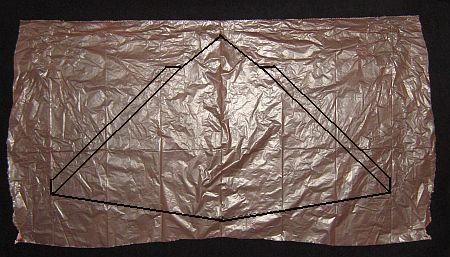
- remove the spars from the plastic, then connect the dots with lines
- fold the plastic over, carefully creasing the fold right down the vertical spar line
- mark dots over top of the ones showing through the plastic, then open out the plastic and draw in the remaining lines
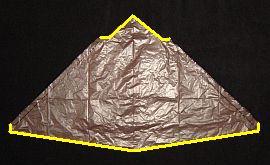
- carefully lay down tape along the nose edge and trailing edges of the sail, as per the plan, not worrying about the excess bits at each end
- with scissors, carefully cut along all the black line, which will trim off the excess bits of tape as you go
A TIP: Overlap the tape over the black lines, just a bit. This way, when you cut along the black, you are actually cutting tape. This is so much easier than cutting light plastic. Even blunt scissors work fine! The tape's a bit hard to see in the photo, but it's there on those edges.
How To Make A Delta Kite Frame
- replace the bamboo spars over the plastic, using the corners and edges to align them
- if the leading edge spars are curved slightly, make sure they curve toward each other
- place 2 small pieces of paper to protect the table, as per the photo
- carefully apply glue around the 3 joints, removing excess dribble from the plastic with a pointed skewer, if necessary
While this is drying, you can get on with the bridle...
How To Make A Delta Kite Keel
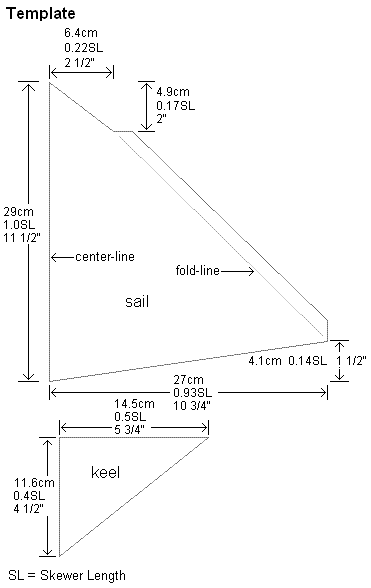
- mark out a triangle on some spare plastic, as per the dimensions on the plan
- cut out the keel from the plastic and tape down 2 lengths of flying line onto it, as per the plan
- now flip the plastic over and tape down another 2 lengths of flying line, directly over the first 2
- also lay down tape along the remaining edge of the keel, on both sides of the plastic
- reinforce the keel by sticking down and wrapping extra bits of tape where the pieces of line come out, making sure the plastic remains flat
- where the 4 pieces of line come together, tie a knot close to the plastic, then tie another one further out, as per the photo

Note: In the photo, the keel is on top, the plastic sail is next, and then the bamboo spars are on the bottom. At this point you need to make sure the glue is dry on the frame. If it is... - fold over and tape down the sail plastic over the leading edge spars
- fold tape over the ends of every spar except the cross spar, so the sail plastic can't slip up and down the spar
- poke the top 2 holes in the plastic sail where indicated on the plan, thread the keel lines through and tie off tightly
- poke the bottom 2 holes in the plastic, using the keel to find the exact spot, thread the lines and tie off tightly
- with the keel flush against the plastic sail, add a short strip of tape on each side near the middle, attaching it to the sail plastic
How To Make A Delta Kite TailMaking a tail for a simple kite is very easy. However, if you would like to copy my MBK Delta kite design exactly, try the following. It works well and is just a little more interesting to make than a long straight ribbon. 
This tail is made up of just one large freezer bag cut into rings about 3 cm (1 inch) wide. I found dividing the bag into 8 rings gave the right ring width. A tip... No need for perfectly straight lines here, just cut the plastic by eye. Firstly cut off the closed bottom of the bag, so the bag becomes a tube of plastic. Then, keep cutting the tube(s) in half until you have 8 rings, all about the same width.

The photo shows 3 rings looped together, with one knot pulled tight and the other one left loose to show you how it's done. Loop rings together until you have a tail about 3 or 4 times as long as the kite itself. Keep the spare loops, you might need to put 1 or 2 on a wing tip later, if the kite pulls off to one side all the time. For a slightly more efficient tail, you can try putting a short length of tape across the width of both ribbons in each loop. This helps to hold the ribbon flat, hence it drags at the airflow a bit more.
If you can find light enough plastic shopping bags, you might try using colored loops to make the kite tail easier to see in the air. To attach the tail to the kite, just push one end between the vertical spar and the sail, at the bottom end of the kite. Then thread the other end of the tail through the loop you just pushed through. Simple! If you don't tighten it too much, the tail will always be easy to remove later, even after flying. At this point, you've pretty much finished learning how to make a Delta kite!
How To Make A Delta Kite - Finishing Off
This kite benefits from a slight bow in its cross spar for extra stability. First, flip the kite over so the plastic sail is against the table. - take a length of flying line about 3 skewer lengths long, tie a simple loop into one end, and slip the loop over one end of the cross spar
- a short distance from this knot, tie another simple loop into the line
- thread the remaining line around the other end of the cross spar and back through the loop
- holding a slight bow into the spar, pull back the line and wind it at least 4 times around the spar end, to hold the tension
- check that it looks like the photo, then tie off with a couple of half hitches around the tensioned line
- using the scissors, snip off excess line dangling from any knots on the kite

Finally, make up a flying line. I keep things extremely basic with a simple winder made from a small rectangular piece of wood. A rounded file with fairly coarse grade will quickly create a curved cut-away on the top and bottom of the winder. About 50 meters (150 feet) of line is enough to give a new kite a good test fly. Put a simple overhand loop into the end of the flying line, then attach it to the kite using a Lark's Head knot. Very simple, I've tried to make it clear in the photo. Doing it this way makes it easy to remove the line later. With this kite, I'm confident that if you built it and attach the keel with reasonable accuracy according to the plan, it should need no further adjustment. Just like the bought ones! If you want to, you could experiment with the amount of bow and the length of tail to get it even more stable.
As a finishing touch, you might want to decorate the kite somehow. I don't really want to suggest anything in particular, since this can be completely up to your own creativity! Two tips though... - make it bright so you can see the kite better!
- try not to add too much weight, otherwise the kite might not fly in lighter breezes

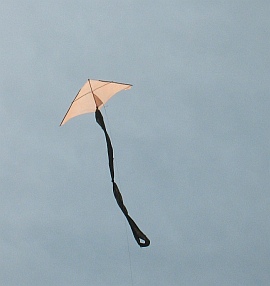
Here's a picture of the completed MBK Skewer Delta Kite in flight, soon after launch.
How To Make A Delta Kite - Flying TipsBefore flying, just check the kite's balance. Hang the kite by the keel and see if one side seems to hang lower than the other. If so, double check by placing the vertical spar on the tips of your fingers, at the nose and tail ends of the kite. Does the same wing go down? If so, keep adding short pieces of tape to the sail near the wing tip until the balance improves. Now hold the kite under its nose and tail, with the keel hanging down, and suddenly take both hands away. Does the kite nose down and fly forward? If so, keep adding tape across the trailing edge of the sail, near but not touching the tail, until the kite shows only a very slight tendency to dive. Assuming there is some breeze, just dangle the kite at arm's length until the wind catches it. As long as you feel the kite pulling, let out line slowly by letting it slip through your fingers. Another approach is to get a helper to hold the kite up and let it go, with maybe 10 or 20 meters of line let out. This way, the kite soon gets high enough to make it easy to let more line out. Have fun flying, and I hope you've enjoyed learning how to make a Delta kite!
Last updated: 25 Jan 2008
Return to How To Make A Kite from How To Make A Delta Kite
All the way back to Home Page

|