- Home Page
- Kite Plans
- Delta Wing Kite
A Delta Wing Kite
Easy to Make, in any Size
A delta-wing kite can look either bird-like or like an aircraft in the air, depending on its design. Some are rather rigid and accelerate quickly this way and that in response to gusts in the wind. Others just float and loll about, distorting in subtle ways as the wind varies.
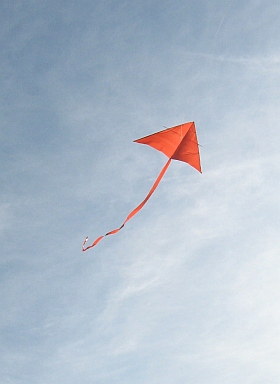 MBK Simple Delta
Deltas are a pretty popular design these days, so they can be seen in
a large range of sizes. The characteristic sail shape never changes
much, though, otherwise it wouldn't be a delta! See our Simple Delta design in the photo.
Our little 1-Skewer Delta design
requires a tail, but is then a good light-to-moderate-wind flyer.
Initially, we made a few in clear plastic while experimenting with a
few details of the construction.
More recently, this kite has been made more visible by doing the sail in orange plastic and using a simple ribbon tail made from black plastic. Also, the glued horizontal spar has been replaced with a floating spreader like bigger kites of this type.
Next up in size comes the 2-Skewer Delta, which also requires a tail—but only a short one! Any lightly built delta-wing kite is good in thermal conditions, and our 2-Skewer version is no exception. It's great to watch it charge around overhead, riding the patches of rising air that come through.
And I mustn't forget the little Paper Delta too, which is the last kite in the Paper Series. These kites feature rigid spars, but everything is formed from copier paper and sticking tape! Testing ensures that each paper kite flies over 200 feet up, can stay up for at least 20 minutes unaided, and will last for more than 3 hours of flight time.
Eventually, we started making larger kites like the Dowel Delta. This one has had just one revision, which resulted in simpler construction and a wider wind range. The original was an ultra-light-wind kite really, which would start to misbehave in even moderate winds! There's something about deltas, isn't there, as they point their nose at the sky on the way up—as if to say "up there is where I belong."
Just like the 1-Skewer designs were doubled into 2-Skewer designs, I did a similar thing to the Dowel Series designs. Among other types, the 2.4 m (8 ft.) span Multi-Dowel Delta was created!
Down below is a photo or two and a video of all the MBK Deltas. This illustrates the end result in case you decide to use our instructions to make a delta-wing kite for yourself.

On this site, there's more kite-making info than you can poke a stick at. :-)
Want to know the most convenient way of using it all?
The Big MBK E-book Bundle is a collection of downloads—printable PDF files which provide step-by-step instructions for many kites large and small.
That's every kite in every MBK series.
A lot of people have shied away from making our Skewer or Dowel kites due to their complexity or the need for gluing. Hence I did a small series of ultra-basic kites, including the Simple Delta, which you've seen already on this page.
The leading edges are about 1 meter (nearly 3 1/2 feet) long. There's no keel and no gluing! In light winds, it can be flown on 20-pound line, but we usually use 50-pound line just to be safe.
In keeping with the "absolute simplicity" concept, this delta-wing kite has a single ribbon tail. The tail is cut from the same plastic that is used to make the sail.
1-Skewer Delta Kite
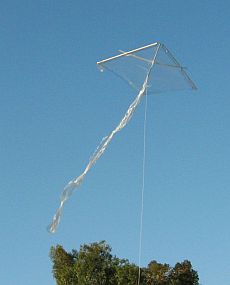 Original 1-Skewer Delta
This dinky little number is called the 1-Skewer Delta. You see, each spar is a 29 cm (11 1/2 in.) bamboo BBQ skewer.
The original was made from clear freezer-bag plastic, which made it almost impossible to see against a gray sky. It's a good little flier, though!
We flew this one on 50 meters (150 feet) of 20-pound line. It doesn't need that strength, but we also flew our 2-Skewer kites on the same line.
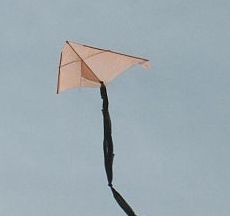 MBK 1-Skewer Delta
In the photo is the latest version of the 1-Skewer Delta in orange garden-bag plastic. The tail is cut from a cheap black garbage bag, which contrasts with the sail color.
Despite using the same number and length of bamboo skewers, this design has a little more sail area than the original—good for light-wind flying!
Check out the video below, which shows this kite in a light evening breeze. See how it starts to tip-wiggle when the wind strength drops for a few moments. I've seen really big deltas do this, too, when flying at the extreme bottom end of their wind range.
2-Skewer Delta Kite
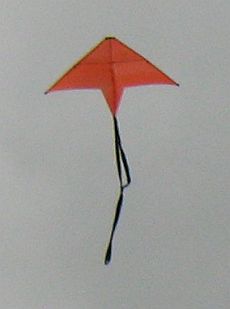 Original 2-Skewer Delta
The 2-Skewer Delta is, as the name suggests, exactly twice as tall as the 1-Skewer design. This gives it four times the sail area with not much more than double the weight. Hence, it's pretty good in light winds.
The delta-wing kite pictured has two-ply plastic that makes it a little heavier, but it is still a good performer.
In moderate winds, the 20-pound line tightens up, and the original delta would start to porpoise rapidly if the wind strength picked up even further.
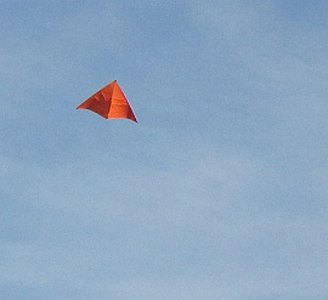 MBK 2-Skewer Delta
The latest 2-Skewer Delta reverted to a simpler and more conventional delta-shaped sail. Other design changes managed to get rid of the porpoising problem. In fresh winds, this version simply tucks its wingtips in and holds on!
The kite is a real pleasure to fly in warmer weather, when patches of rising air tend to loft it directly overhead.
Dowel Delta Kite
 Original Dowel Delta
For quite a while, the MBK Dowel Delta was our largest delta. This one was designed from the start to be tailless. A generous keel helps to keep the kite stable.
Actually, the original dowel design had more keel than the current design. The rear end of the keel flapped in the breeze like another tail! You can see that in the photo.
This kite proved too light and flimsy for general outdoor flying. Of course, in very light wind, it would return some amazing flights. In those conditions, it would have been quite safe to fly on mere 20-pound line.
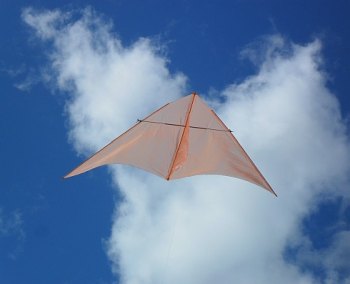 MBK Dowel Delta
The latest Dowel Delta—the third version in fact—has quite a good wind range for a homemade light-wind delta. It has been flown in very gusty air up to around 20 kph. There it is in the photo.
The Dowel
Delta is also a real floater and will fly at high line angles in light
winds. Size? It's about twice as tall as the 2-Skewer Delta, so that's
about four times the sail area.
Compared to the 1-Skewer version, the dowel version has about 16 times as much sail area.
The video below gives a good closeup view of the MBK Dowel Delta flying on a short line in light wind:
Multi-Dowel Delta Kite
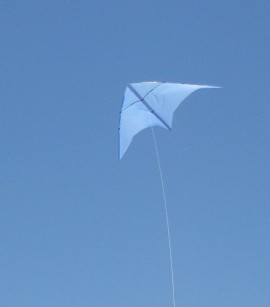 MBK Multi-Dowel Delta
The big daddy of all MBK deltas is the Multi-Dowel Delta kite. This beast is 4.8 m (16 ft.) from tip to tip. Although this kite likes light wind, it can cope with gentle breeze-strengths by having the spreader set to allow more billow in the sail. That, plus a small drogue from the tail end of the spine, gives the kite a reasonable wind range.
The leading edges and the spine each plug together from two 1.2 m (4 ft.) lengths of Tasmanian oak dowel. That's using my completely unpatented dowel-drum method. :-) Like Hargrave, the box-kite pioneer, I'm unconcerned with patents.
This kite is a graceful sight when it soars about in light wind and thermal conditions on several hundred feet of 200-pound Dacron line.
In the video below, the breeze is pushing the kite a little harder. You can hear the plastic rustling at times!
That's about it for this page on the delta-wing kite—in several convenient sizes! I hope you enjoyed the pics and the info.
As mentioned earlier, there's more kite making on this site than you can poke a stick at. :-)
Want to know the most convenient way of using it all?
The Big MBK E-book Bundle is a collection of downloads—printable PDF files which provide step-by-step instructions for many kites large and small.
That's every kite in every MBK series.
