- Home Page
- Kite Plans
- Rollers
Roller-Kite Plans
For All The MBK Rollers
These roller-kite plans and hints are aimed at summarizing the more in-depth instructions to be found in the How To Make A Kite section of this website.
For each of the roller plans below, there are also a pair of plan-view photos.
The picture on the left is of the front surface. That is, the side of the kite which faces the flyer. The other photo is of the back surface, which exposes the spars.
For all three designs:
Attach flying line to the bridle with a shiftable knot, for later trimming.
Also, the kites work well with light single-ply plastic for sail material. Many large plastic bags are suitable.
The sail tethers are just lengths of flying line, attached to the upper sail with strips of clear sticky tape, and knotted to the lower horizontal spar with Half-Hitch knots for easy unpicking and adjustment.
On this site, there's more kite-making info than you can poke a stick at :-)
Want to know the most convenient way of using it all?
The Big MBK E-book Bundle is a collection of downloads — printable PDF files which provide step-by-step instructions for many kites large and small.
Every kite in every MBK series.
Dowel Roller-Kite Plans
Plan-View Photos
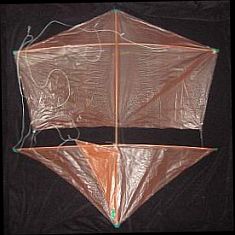 Front
Front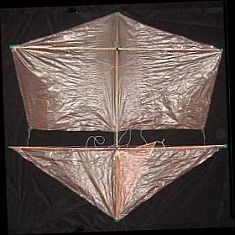 Back
Back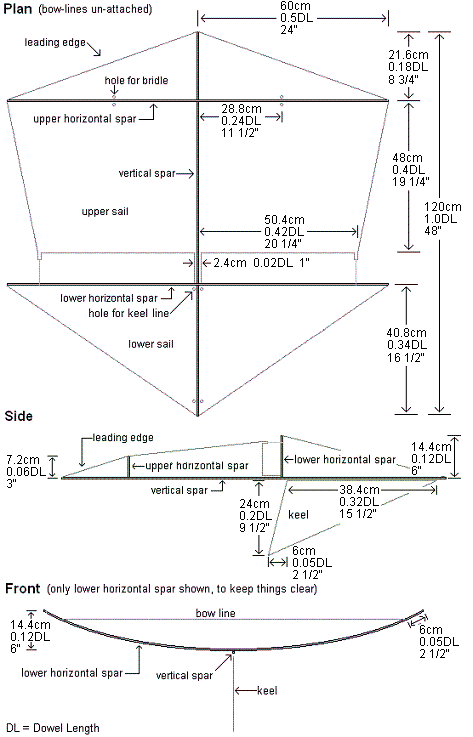
Tips and Hints
- Work with one Dowel Length equal to either 120 cm of 5 mm dowel, or 48 in. of 3/16 in. dowel.
- Reinforce the sail edges by adding clear sticking tape over the outlines, then trimming back to the outlines as you cut out the sail. To save weight, don't reinforce the trailing edge of the upper sail or the leading edge of the lower sail.
- Secure the sail to the spar ends using short lengths of electrical insulation tape.
- Add tabs to the lower sail leading edges, so you can fold them over the spar and tape down.
- Run a length of sticky tape the full length of the kite's centerline to help prevent stretch.
- Reinforce the upper sail corners where the ties are attached. I used short pieces of sticky tape, stuck to each other where they leave the plastic.
- Use a bridle loop of length 1.0 DL (120 cm, 48 in.), going to each side of the upper horizontal spar.
- Run a 3.0 DL (360 cm, 144 in.) bridle line from the center of the loop to the bridle attachment point of the keel.
- You might find stability to be marginal in all but very light
conditions. To extend the wind range, try adding weight to the trailing
edge of the keel near the vertical spar tip. A couple of 5c pieces
worked wonders for me!
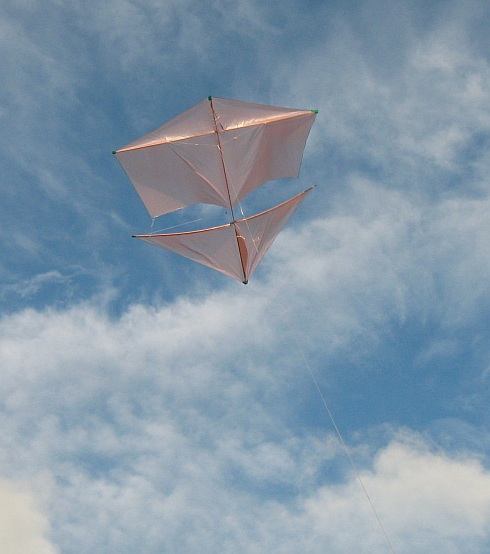 A most photogenic sparred kite, the roller
2-Skewer Roller-Kite Plans
Plan-View Photos
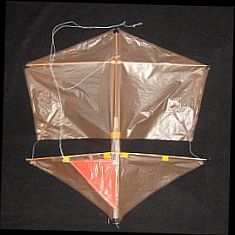 Front
Front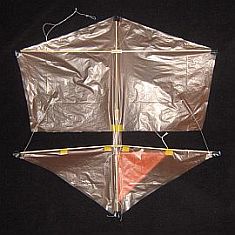 Back
Back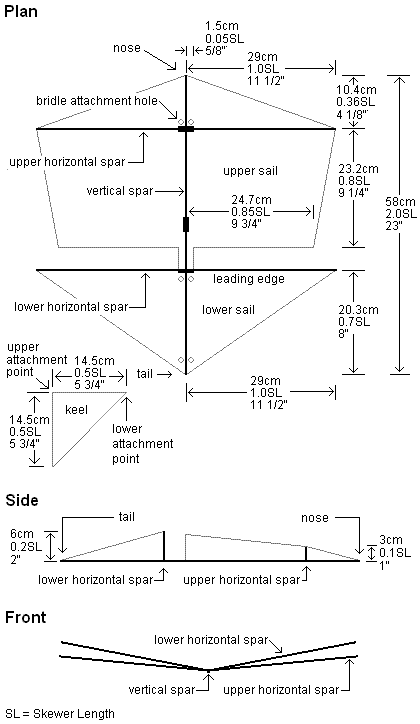
Tips and Hints
- Reinforce the skewer joins with short lengths of skewer, 0.1 SL (3 cm, 1 in.) long, glued to one or both sides of the join as in the plan. While gluing the spars with dihedral, the short reinforcers stay flat on the table.
- Reinforce the sail edges by adding clear sticking tape over the outlines, then trimming back to the outlines as you cut out the sail. To save weight, don't reinforce the trailing edge of the upper sail or the leading edge of the lower sail.
- Secure the sail to the spar ends using short lengths of electrical insulation tape.
- Use four more small pieces of tape to secure the leading edge of the lower sail to the lower horizontal spar.
- Try a bridle line about three times longer than the kite itself, tied between the uppermost attachment point and the keel.
There's our original MBK 2-Skewer Roller below. A drop in wind speed has caused it to momentarily hang on the upper bridle leg.
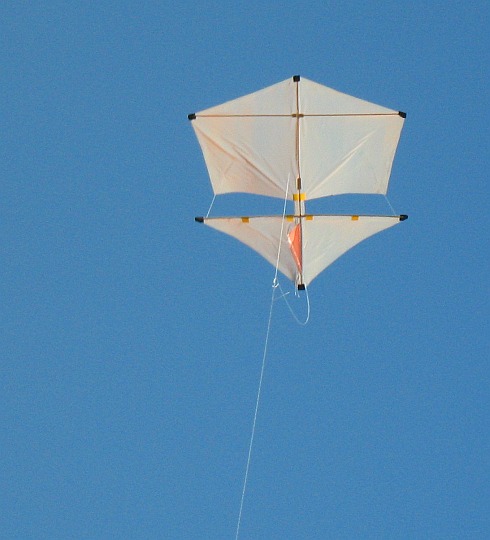 Modest flyer, but nothing a good thermal won't fix
1-Skewer Roller-Kite Plans
Plan-View Photos
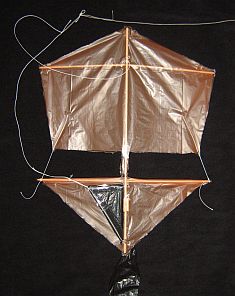 Front
Front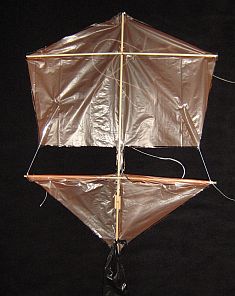 Back
Back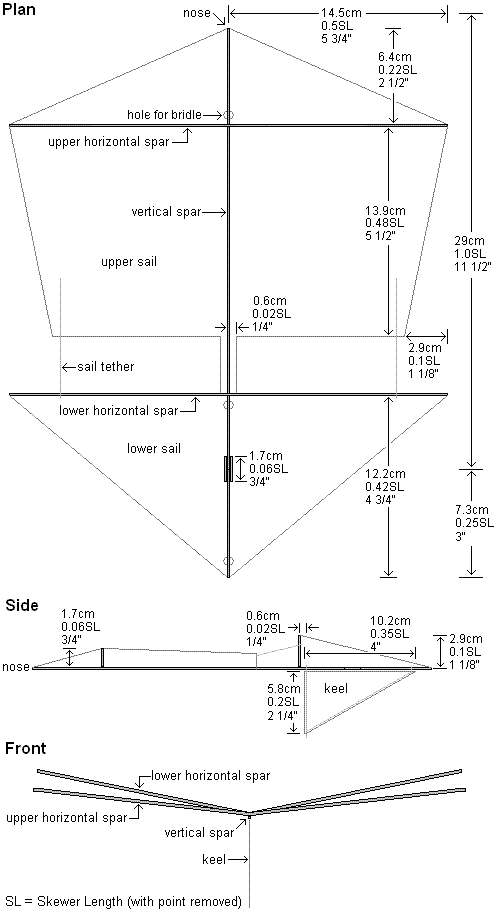
Tips and Hints
- Secure the sail to the spar ends using short lengths of clear sticky tape.
- Include tabs along the leading edges of the lower sail. On each side, fold the tab over the spar and stick down using three squares of clear sticky tape.
- Try a bridle line about three times longer than the kite itself, tied between the uppermost attachment point and the keel.
- The 1-Skewer Roller kite requires a tail. Start with a tail about six times as long as the kite itself.
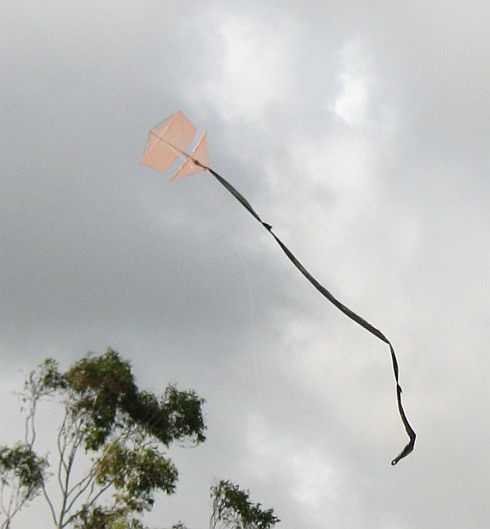 A tiny roller is a curiosity that needs a long tail
Out in the Field
Roller-kite stories of my real-life flying experiences are worth checking out!
Illustrated with photos and videos, of course.
I hope one of these roller-kite plans is just right for you!
As mentioned earlier, there's more kite making on this site than you can poke a stick at :-)
Want to know the most convenient way of using it all?
The Big MBK E-book Bundle is a collection of downloads — printable PDF files which provide step-by-step instructions for many kites large and small.
Every kite in every MBK series.
