Making a Kite?
Four Things to Consider
Are you thinking about making a kite? Here are some ideas to help you make the right choice. How about some specific kite types for various wind speeds, locations, age groups, and patience levels! If you have plenty of experience in the hobby, perhaps you know all this already, but if not...
Over a period of several years, I made and flew a whole range of single liners. It started with eight different kinds of kites, in three sizes, which made 24 kites. However, even more were added in later years.
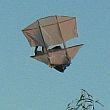
The smallest of these MBK kites were constructed from bamboo BBQ skewers, like the little 1-Skewer Dopero in the photo. The biggest designs used hardwood dowel. The sail material for most of these kites was light plastic sheet, such as garden bags or trash (garbage) bags.
This brings me to a point—most MBK kites are fairly plain to
look at. If you are something of an artist, you can change that, but
just be careful not to add too much weight! When making a kite, "the
lighter the better."
An exception is the MBK Paper Series, which opens up artistic possibilities with colored paper. That's not to mention drawing or painting on plain-paper sails!
On this site, there's more kite-making info than you can poke a stick at :-)
Want to know the most convenient way of using it all?
The Big MBK E-book Bundle is a collection of downloads—printable PDF files which provide step-by-step instructions for many kites large and small.
Every kite in every MBK series.
Wind Speeds
All the flat or bowed MBK designs are fairly light-wind kites, although some of them can tolerate fairly fresh winds. Of course, the box kites love fresh or strong wind! Here's just a selection:
Light Wind
You can only just feel the wind on your face. Leaves are moving but not the branches:
- Simple Sled
- 1-Skewer Delta
- 2-Skewer Sode
- 2-Skewer Dopero
- Dowel Delta
- Dowel Rokkaku
Moderate Wind
Small branches are moving around, and the leaves are making some noise:
- Simple Delta
- 1-Skewer Diamond
- 1-Skewer Roller
- 2-Skewer Diamond
- 2-Skewer Delta
- Dowel Diamond
- Dowel Sode
Fresh Wind: Clouds scud slowly across the sky; medium-sized branches are swaying. There's lots of leaf noise:
- 1-Skewer Barn Door
- 2-Skewer Barn Door
- 2-Skewer Box Kite
Locations
This is pretty simple. Winds tend to be much smoother coming directly off the ocean. Hence, sled kites have an easier time staying inflated and flying properly, down at the beach! Of course, in smooth winds, any kind of kite will fly in a more predictable way. Sometimes the wind direction will shift slightly, shifting the kite around with it, but that's about all.
For making a kite to fly in smooth winds, try one of the following:
- Simple Sled
- 1-Skewer Sled
- 2-Skewer Sled
- Dowel Sled
The further inland you go, the more gusty and unpredictable the wind becomes. Large obstacles break up the airflow near the ground, and the sun's heating produces rising bubbles of warm air called thermals. Thermals cause changes in wind direction and are surrounded by small-scale turbulence. Sled kites hate it and are prone to folding up and plummeting to the ground :-( On the other hand, it makes flying other types of kites more fun, if you ask me!
Age Groups
If you are making a kite for a youngster, you have to keep in mind their strength. Little kid, little kite. That's logical enough. Having said that, in very-light-wind conditions you can give the flying line of a big kite to a young child for a few moments. If the kite is barely pulling, the child will really enjoy the experience. We know this from experience with our 3-year-old boy. Our definition of a "big" kite? Anything more than a meter (3 feet) from tip to tip.
Age 3 to 5
Besides wind strength, you probably don't want to go to too much trouble making a kite for a small flyer. After all, they could damage it easily in their enthusiasm to handle it and tow it around. Hence, it's hard to go past the ever-reliable and easy-to-make diamond kite. If you are down at the beach, the ultra-simple sled might be a good choice too:
- 1-Skewer Sled
- 1-Skewer Diamond
- 2-Skewer Diamond
Age 6 to 12
An older child might enjoy the challenge of helping you construct a more interesting kite. The 2-Skewer Series kites are ideal. Their performance in light winds is great, on 50 meters (160 feet) of 20-pound line. That's high enough for satisfying flying yet short enough to see everything the kite is doing:
- 2-Skewer Delta
- 2-Skewer Roller
Age 13 to 113 For you or your teenagers, you might enjoy the larger-sized Dowel Series kites. If you just want to get out and fly as soon as possible, try these:
- Dowel Sled (best in smooth or very light winds)
- Dowel Diamond
Otherwise, you might want to take on the challenge of some of the more complex 2-Skewer or Dowel kites:
- 2-Skewer Dopero
- Dowel Delta
- Dowel Roller
These will go straight to 400 feet on 50-pound line, in a light or moderate breeze. Since the Dowel Series kites are designed to pack up into a thin package like a sled kite, they are easy to transport despite the 1.2 meter (4 foot) spars.
Patience Levels While Making a Kite
Just how much effort are you prepared to put in, when making a kite? Since starting this site I have come to realize that only the very keenest kite fanciers are bothering with my more involved designs! For example, the 2-Skewer Dopero or Dowel Barn Door kites.
Here's something to keep in mind with the Dowel Series designs... If you are lucky enough to just walk out the back door and fly, there's no real need to follow the detailed instructions under How To Make A Kite, since these describe the transportable versions. Instead, just do the best you can from the Kite Plans pages and hence save some time.
"I Wanna Fly NOW"
The obvious choice here is one of the three Simple Kites! Otherwise...
You could try the 1-Skewer Diamond. This is small, quick, easy, and with a long enough tail, has a surprisingly good wind range!
The Dowel Diamond, made from plans, is quite quick to make and is a satisfyingly big kite to fly. With no tail, it could be a bit of a talking point too, for people passing by!
"I Want Performance, But Not A Long Build Time"
The 1-Skewer Sode with a long tail is a great little performer over a decent wind range, despite its small size. The kids will love it too!
The 2-Skewer Rokkaku has a few fiddly skewer joins to glue. Apart from that, it's quite a simple kite and will thermal straight to 400 feet on 20-pound line! It's one of my favorite kites actually.
Try the Dowel Barn Door from plans for making a kite that's reliable in moderate winds. Add a short loop of tail for extra stability in fresher winds.
"I Want Fantastic Performance, Regardless Of Build Time"
For its size, the 1-Skewer Dopero will impress, on a light 50 meter (160 feet) line. I once made one from black plastic, and what a great little aircraft it turned out to be. It was responsive to thermals just like a much bigger kite. Just be careful to avoid overly heavy bamboo when making a kite from skewers. The ones that are lighter-colored and bend a bit more are generally lighter.
Our 2-Skewer Dopero strutted its stuff at a big kite festival in March 2009. While expensive large deltas and rokkakus floundered in the very light air, this plastic-and-bamboo kite flew right up to the altitude limit at 400 feet. There it floated in a lonely display of light-wind performance for all the crowd to see. I heard comments later about "that little orange kite..."
Most people love deltas. There's something about that triangular, bird-like shape that draws attention. The Dowel Delta might require a little work on the leading edge spars to get the kite flying straight and true, but the effort is worth it. This kite will delight you with its light-wind performance and graceful floating flight.
I hope these thoughts on making a kite help you to pick a rewarding kite-building project, perhaps from my e-book resources.
As mentioned earlier, there's more kite-making on this site than you can poke a stick at :-)
Want to know the most convenient way of using it all?
The Big MBK E-book Bundle is a collection of downloads—printable PDF files which provide step-by-step instructions for many kites large and small.
Every kite in every MBK series.
