Home
what's new?
kite flying stories
site map

Community
newsletter
YOUR stories!
YOUR pictures!
visitor pages map

Kite Making
simple kites
how to make...
kite plans
kiting knots
how to fly...

Single Line
kids' kites
chinese kites
box kites
types of kites
other single liners
aerial photography

Multi Line
power kites
stunt kites

Miscellaneous
kite ebooks
kite pictures
kite festivals
Adelaide events
kite flying blog
about the webmaster
 

How To Make A Barn Door Kite

Complete Instructions For The MBK Dowel Barn Door

This set of instructions on how to make a Barn Door kite assumes you know absolutely nothing about kite making. You might already have some of the simple tools and materials required. Anything you don't have is easily bought. If not exactly what I used, then at least something pretty similar!
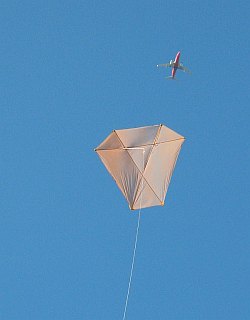
The instructions on how to make a Barn Door kite might look awfully long, but that's because they are so detailed. For those who like pictures, every detail is illustrated with photographs too. Just quickly work your way through from top to bottom, skimming over any detail that you don't need.

The MBK Dowel Barn Door is a large tail-less design based on the traditional American kite. This kite is good in light to moderate winds, and easily copes with gusty inland air. The kite is designed to roll up into a slim cylindrical package like a Sled, thanks to the 4 detachable corners of the sail and the toggle-linked bow line. Setting up on the flying field takes around 3 minutes, with some practice. Of course, if you have room, you can always leave this Barn Door ready-to-fly. When you are familiar with setting up and flying the Dowel Diamond, move up to this Barn Door for more of a challenge!

Now's the time to read up on the kite making tools and materials required for making a Dowel Barn Door, if you haven't already.


How To Make A Barn Door Kite - Sail

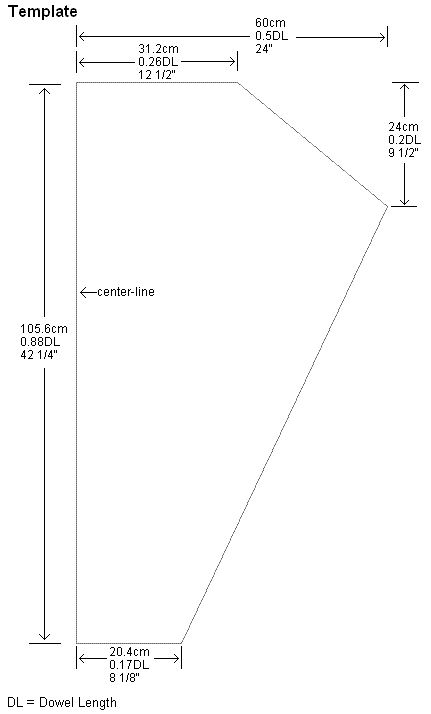
Make a barn-door kite - template


Make a barn-door kite - corners 1

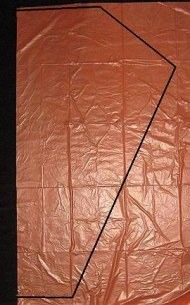
The template shown above represents one side of the kite sail. You will now transfer these measurements to the sail plastic as follows...

  • Firstly, take a large bag that will fit the entire Template shape within one side, and lay it flat on the floor.
  • Mark dots on the plastic which correspond to the corners of the Template. There is no need to use a T-square, or an extra-long ruler since any small errors in position will be duplicated on the other side of the sail.
  • Using the marking pen, rule lines between the dots, as in the photo. For lines longer than the ruler, just add a few extra dots using one of the dowel spars as a ruler! Then it's easy to connect the dots with a ruler. It's probably best not to rule the whole line with the dowel, since it bends easily.


Make a barn-door kite - corners 2

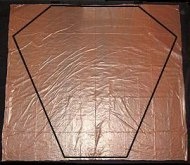
  • Flip the plastic bag over, and trace over all the black lines using your marker pen and ruler.
  • Cut out a rectangular section of the bag containing the kite sail, open it out and lay it flat on the floor - you can now see the complete sail outline, as in the photo.


Make a barn-door kite - sail edges

When doing the following, most of the width of the tape should be inside the kite's outline. Use a single length of tape for each line. Hold it out straight, touch it down to the plastic at one end, then at the other end, dab it down in the middle, then press down all along its length.
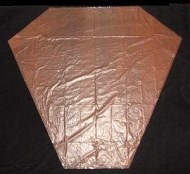
  • Lay clear sticking tape along all the lines, letting it overlap at the corners.
  • With scissors, cut along all the black lines. This will leave most of the width of the sticking tape inside the sail outline.

Make a barn-door kite - corner straps

This is a good time to add corner straps to the top left and top right corners of the sail. Make them a length of 0.3DL (360mm, 14 1/2") each, since they are tied off around the horizontal spar later. See the photo over there...

Make a barn-door kite - sail pockets

The bottom corners of the sail require pockets. The dimensions don't have to be exact. Just copy what you see in the photo over there, which shows the bottom right pocket.

  • First you cut out a triangular shape from some spare sail plastic, and lay it down on the sail corner.
  • Next, cut off 2 short pieces of insulation tape, to cover the side edges of the pocket. Fold around and under the sail plastic.
  • Then cut a square pice of insulation tape and fold it right over the point of the corner. This will prevent the spar poking through there.
  • Lay another piece of tape across the top edge of the pocket, and fold under the sail where necessary. The corner should now look like the photo.
  • Do all these steps again for the bottom left corner of the sail.


How To Make A Barn Door Kite - Spars

For this barn-door, you need long lengths of 5mm (3/16") wooden dowel. It is easily cut to the lengths required with a small cheap hack-saw.

Make a barn-door kite - spars


Note: The length of bought dowel can be somewhat inaccurate. So if you have bought 2.4 meter lengths of dowel, you might have a couple of centimeters less than you bargained for! Hence I cut my 1.2 meter spars from 1.8 meter lengths of dowel.

  • Lay down dowel diagonally over the sail, cutting off a length that goes from the top-left corner to the bottom-right corner. This is one diagonal spar.
  • Do the same for the other diagonal spar which goes from top-right to bottom-left.
  • Lay down dowel horizontally over the sail, and cut it to length so it goes from the left-most corner to the right-most corner. Mark this dowel with an 'H' since it is your horizontal spar.
  • Cut off a very short 0.01DL (12mm, 1/2") length of dowel. This will be used as the bow-line toggle.
  • Using your wood file, round off the tips of every piece of dowel you cut off.

Now there's a little work to be done on the horizontal spar. Use 20 pound flying line if you have some, otherwise just use some of your 50 pound flying line. With this kite laying on the floor, each tip of the horizontal spar will be 0.08DL (96mm, 3 3/4") above the floor.


How To Make A Barn Door Kite - Spar Ties

Each diagonal spar will have a shoe-lace tie attached to it, which will be used to lash the spar to the horizontal spar before flying.

Make a barn-door kite - preparing diagonal spars

  • Firstly lay down the 3 spars over the sail, carefully lining up each tip with its corresponding sail corner. Make marks on both the diagonal spars showing where they cross the horizontal spar. Remove the horizontal spar.
  • Measure and cut off two 0.18DL (216mm, 8 3/4") lengths of shoe-lace.
  • Measure and cut off two lengths of insulation tape that are long enough to go all the way around the dowel, plus a little more.
  • Attach the shoe-lace ties at the spar-crossing points which you marked on the diagonal spars. Each tape wraps around the dowel, attaching the tie to the dowel. See the photo above right.
  • Take a 0.3DL (360mm, 14 1/2") length of 50 pound flying line and tie it around one of the diagonal spars, roughly where the spars will cross. The knot will be positioned precisely later. Use a Granny Knot right in the middle, so there is an equal amount of line coming out from each side of the knot. See the photo below...

Make a barn-door kite - spar crossing tie


Make a barn-door kite - spar tips taped down

  • Prepare 4 lengths of electrical insulation tape, each one about 4 times longer than it is wide. Stick them by a corner onto something handy like a table edge. You can remove them one at a time as needed.
  • Lay down the horizontal spar, lining it up with the corresponding corners of the sail. TIP: Rest the horizontal spar over the 2 diagonal spars, and weight the center down with a book. This should keep the bow-line knots on top, and the spar curvature pointing in the right direction while you get the tapes on.
  • Cap each end of the spar with tape, by sticking it down over the dowel and plastic then folding it under the plastic to stick on the other side - a bit tricky, take your time!
  • For added strength, put another piece of tape across the cap, folding the corners around and under the sail plastic. The photo up there shows the completed cap.
  • Do the other tip of the horizontal spar similarly, using the last 2 pieces of tape.


How To Make A Barn Door Kite - Bridle

Make a barn-door kite - upper bridle loop

  • 0.27DL (324mm, 13") from each tip of the horizontal spar, make a mark on the spar. Poke a hole in the plastic under the mark.
  • Cut off 1.5DL (1.8m, 6 ft) of 50 pound flying line.
  • Tie a Loop Knot into each end. Make them as small as possible, since the loops aren't being used, just the knots!
  • Pass one end through one of the holes, twice around the horizontal spar, and out through the hole again. Tuck the loop knot through and pull tight against the dowel to form a Double Wrap Slip Knot. There it is in the photo. You can see the 2 wraps of line and the hole in the plastic sail. The knot itself is hidden underneath.
  • Do similarly on the other side of the kite, with the other end of the line. You now have an upper bridle loop attached to the kite.


Make a barn-door kite - lower bridle line

  • With the diagonal spars in their pockets and lined up with the corner straps, make a hole in the plastic right where the spars cross.
  • Make sure the flying line tied to the top diagonal spar is right over where the spars cross. Then wrap each loose end around the crossed spars - twice. The loose ends should go around in opposite directions. See the top photo.
  • Pull the lines tight. Tie them off tightly against the dowel, right near the hole in the plastic. A Granny Knot is fine.
  • Pull the 2 loose ends together, and tie them into a Simple Knot near the end of the line. See the middle photo, where the line has also been fed through the hole in the sail.
  • Now take another 1.5DL (1.8m, 6 ft) length of flying line, and attach one end of it to the middle of the upper bridle loop with a Prusik Knot. This is the lower bridle line.
  • Tie a Loop Knot into the other end. Attach this end to the line which is holding the crossed spars together, using a Lark's Head Knot. See the bottom photo.

Finally, take a length of flying line about 0.2DL (240mm, 9 1/2") long, and tie one end to the lower bridle line with a Prusik Knot. Tie a small Double Loop Knot into the other end, just to get a large knot. There's a photo of this further down, in the section titled Before The First Flight.

At this point, you've pretty much finished making the Dowel Barn Door! However, there is a short Setup procedure to go through before it will fly...


How To Make A Barn Door Kite - Setting Up

Make a barn-door kite - setting up


  1. Spread out the plastic sail on the ground, with the horizontal spar on top.
  2. Slip the top tips of the diagonal spars under the horizontal spar. Then locate the bottom tips in their respective pockets at the bottom corners of the sail.
  3. Locate the top tips of the diagonal spars in their corner straps, and do up the corner straps as in the photo. You can experiment with leaving these done up, so you never have to do them up again.
  4. Do up the shoe-lace ties, attaching the diagonal spars to the horizontal spar. Just a simple knot and bow, exactly like doing up your own shoe-laces, so it's easy to undo.
  5. Attach the bow-line toggle of the horizontal spar.


How To Make A Barn Door Kite - Breaking Down

I don't mean breaking down in grief because your flying session has come to an end - I mean getting the kite packed up ready for transport or storage!

Make a barn-door kite - breaking down


  1. Lay the kite on the ground with the spars on top, and flying line removed.
  2. Flex a little more bow into the horizontal spar with one hand, and slip the toggle out of its loop with your other hand.
  3. Un-do both the corner straps, or just slip the diagonal spars out sideways.
  4. Un-do the shoe-lace ties where the spars cross.
  5. Remove the diagonal spars from their pockets, and rotate them together.
  6. Pull some of the lower bridle line through the hole and place the diagonal spars beside the horizontal spar, on the sail.
  7. Roll up the sail, starting from the top.
  8. Finally, wrap the bridle line around the kite a few times to prevent it un-rolling. There it is in the photo, taking up no more space than a Sled kite. A good way to make a Barn Door kite if you ask me!


How To Make A Barn Door Kite - Before The First Flight

Make a barn-door kite - first flight

Make up a flying line and attach it to the bridle with a Lark's Head Knot. See the photo over there, where the Lark's Head has been left loose.

Lay the kite flat on the floor, with the bridle on top. Hold up the end of the bridle and observe where it is when all the bridle lines have no slack. Then shift the Prusik Knot along the lower bridle line until the end of the bridle sits directly over the horizontal spar. To lock the Prusik in place, take the 2 bridle lines in one hand, the flying line in the other, and pull tight. To unlock it, you just pull the bridle line straight, with the knot in the middle.

Also check that both wing tips leave the floor at the same time when you pull the kite up off the floor by the lower bridle line. If one tip comes up first, adjust the Prusik knot on the upper bridle loop until both tips come up at once.

Check the bridle slip knots on the horizontal spar. Re-tighten if necessary, and put a drop of wood glue on each so they can never come loose or slide along the spar. Finally, where the diagonal spars cross, put a little glue where the lines are tied off against the dowel. Use enough glue so the line sticks to the dowel as well. Be careful not to stick the dowels together though, since they all lay together when the kite is rolled up.

You won't have to wait the full drying time for all this glue to dry, since the amounts are small, and the glue is not under much stress.


How To Make A Barn Door Kite - Flying!

Firstly, if it's very windy outside, stay home! This is a light-wind kite and won't like being launched in a gale. If the wind is too strong, it might not even be stable enough to fly.

Make a barn-door kite - launching

The Prusik knot on the bridle line can loosen off a little over time. If necessary, pull on all the lines to tighten the knot up before a flying session.

Assuming there is some breeze outside, just dangle the kite at arm's length until the wind catches it. As long as you feel the kite pulling, let out line slowly by taking loop after loop off the winder. Be careful when letting line slip through your fingers. If a gust hits the kite, the line could burn you! For a kite this big, it's a good idea to wear a glove.

Another approach is to get a helper to hold the kite up and let it go, on the end of maybe 10 or 20 meters of line. This way, the kite soon gets high enough to make it easy to let more line out.

Have fun flying, and I hope you've enjoyed learning how to make a Barn Door kite!


The Dowel Barn Door Kite eBook is a neat compilation of all this site's info on this specific kite. Plus there is general info to help you towards kite-flying success.


Last updated: 12 Aug 2010


Return to How To Make A Kite from How To Make A Barn Door Kite

All the way back to Home Page


footer for make a barn door kite page