- Home Page
- Better Kites
- ... Box Kite
How to Build a Box Kite
Step-by-Step—Page 1 of 3
The MBK 2-Skewer Box
This set of instructions on how to build a box kite assumes you know absolutely nothing about kite making.
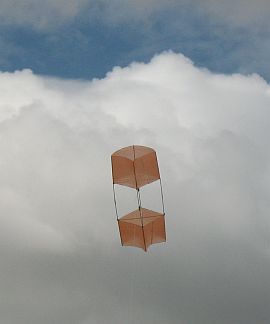 MBK 2-Skewer Box
You might already have some of the simple tools and materials required. Anything you don't have is easily bought. If not exactly what I used, then at least something pretty similar!
The instructions on how to build a box kite might look quite long, but each step is simple to do. Just quickly work your way through, skimming over any detail that you don't need. All in all, it should be quite hard to make a mistake!
If made from 30 cm (12 in.) skewers, the MBK 2-Skewer Box kite is not huge at 58 cm (23 in.) long, with cell panels measuring about 17 cm x 20 cm (7 in. x 8 in.).
This box design is a moderate-to-fresh-wind flyer and requires no tail. That is, unless you are flying in a storm, which is not recommended anyway! If accurately made, this kite can cope with quite strong wind.
I have an enduring memory of flying this kite on a really windy day. The skewers were bending but nothing broke. And then, as I looked across the ground, my wind meter on its little tripod got blown over. That's breezy!

On this site, there's more kite-making info than you can poke a stick at :-)
Want to know the most convenient way of using it all?
The Big MBK E-book Bundle is a collection of downloads — printable PDF files which provide step-by-step instructions for many kites large and small.
Every kite in every MBK series.
How to Build a Box Kite
Main Spars
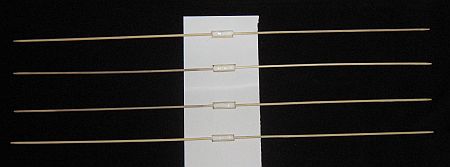
- Snip the point off a skewer—to 29 cm for a 30 cm skewer, or 11 1/2 in. for a 12 in. skewer. This will be one skewer length (1.0 SL) for your kite.
- Snip the points off seven more skewers, to exactly the same length as the first one. These eight skewers will form four main spars.
- From a spare skewer, snip off eight lengths, each just 0.1 SL (2.9 cm, 1 1/8 in.) long. These are the reinforcers which will connect the spar skewers together.
- Lay down the eight spar-skewers, together with the eight reinforcers, and lay wood glue down the joins. See the photo.
- Get down low and look along each spar in turn. Carefully move them as necessary to get each spar as straight as possible, before the glue dries.
How to Build a Box Kite
Cross Pieces
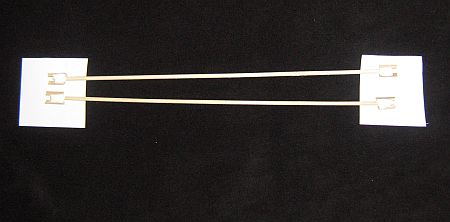
- Take two more skewers, and trim each one to a length of 0.98 SL (28.4 cm, 11 1/4 in.). These are two of the cross pieces—two more will be needed later, but don't make them now.
- From a spare skewer, snip off eight lengths, each just 0.05 SL (1.5 cm, 5/8 in.) long. These will secure the cross pieces to the main spars.
- Arrange these to make two cross-pieces, as in the photo. Lay down wood glue over every join.
How to Build a Box Kite
Sail
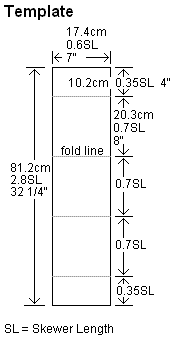
The template down there represents one cell of the kite, laid out flat. Now transfer the measurements to the sail plastic as follows:
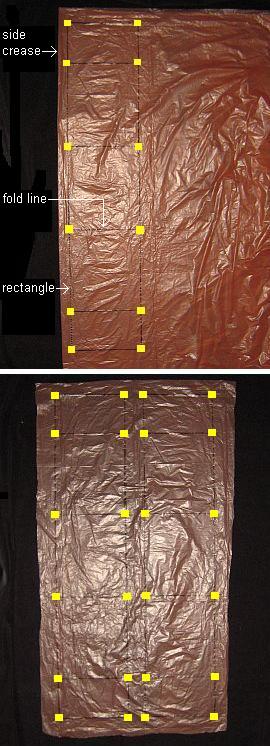
- First, take a light single-ply plastic bag and lay it flat on the table. I use cheap orange garden-bag plastic. The more expensive bags are usually two or three-ply plastic, which is heavier and less see-through.
- Measure and mark the rectangle outline first, with a black marking pen and ruler. Do this near the side crease of the bag, as in the top photo.
- Now measure and mark the fold lines.
- Flip the bag over and trace over all the lines.
- Cut out the plastic containing the two rectangles and open it out, as in the bottom photo.
Like to see a video clip? Just scroll down to near the end of this page.
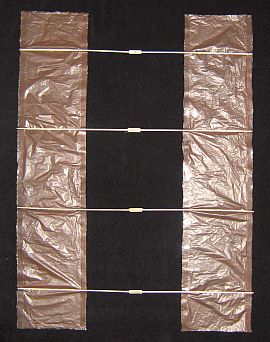
- Cut around the two rectangular outlines with scissors, one at a time. You'll be sorry if you attempt to cut both thicknesses of plastic at once, since the bottom one will tend to slip out of position!
- Arrange the four bamboo spars over the plastic as in the photo, covering up the drawn fold-lines.
- Tack down all eight corners of the sails to the floor or tabletop with small pieces of sticky tape. This stops unintended shifting of the plastic while you are trying to:
- Lay down four long lengths of clear sticky tape, securing the spars to the plastic. The tape is visible in the photo; look for where the plastic is smoother and slightly darker, near the edges.
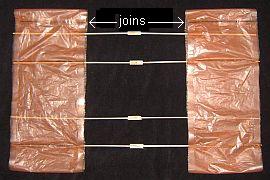
- Remove everything from the tabletop, either pulling off or trimming away the small square bits of tape at the corners.
- Fold the sails, bringing the short edges together and sticking them with tape as shown in the photo.
- Now open the box kite out, and carefully lay down tape along the inside edges as well, to make the two joins even more secure—a bit tricky, so take your time!
As mentioned earlier, there's more kite making on this site than you can poke a stick at :-)
Want to know the most convenient way of using it all?
The Big MBK E-book Bundle is a collection of downloads — printable PDF files which provide step-by-step instructions for many kites large and small.
Every kite in every MBK series.
